Other grades of this product :
| 2-Methyl-4-isothiazolin-3-one hydrochloride Basic information |
| 2-Methyl-4-isothiazolin-3-one hydrochloride Chemical Properties |
| Hazard Codes | C | | Risk Statements | 34-42/43 | | Safety Statements | 26-36/37/39-45 | | RIDADR | UN 1759 8/PG 2 | | WGK Germany | 3 | | HS Code | 2934100090 |
| 2-Methyl-4-isothiazolin-3-one hydrochloride Usage And Synthesis |
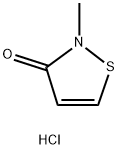
| Uses | 2-Methyl-4-isothiazolin-3-one Hydrochloride is an isothiazolinone based biocide and preservative used in personal care products. It is also implicated as an allergen. It is also used for controlling microbial growth in water-containing solution. | | Application | Methylisothiazolinone (MIT) has been used: as a cytotoxic substance to investigate its effect on bronchial epithelial cells (BEAS-2B cells) and its role in apoptotic cell deathto study the effects of tyrosine phosphorylation on focal adhesion kinase (FAK) activity in the development of neural axons and dendrites | | General Description | 2-Methyl-4-isothiazolin-3-one hydrochloride (MIT) is a derivative of the synthetic isothiazolinone. | | Biochem/physiol Actions | 2-Methyl-4-isothiazolin-3-one hydrochloride (MIT) is a skin sensitizer known to cause contact dermatitis and allergy. It is extensively used in the cosmetic industry as a preservative. MIT is a neurotoxin and its prolonged exposure may lead to neuronal death and inhibition of neurite outgrowth. |
| 2-Methyl-4-isothiazolin-3-one hydrochloride Preparation Products And Raw materials |
|


 日本语
日本语 한국어
한국어 Français
 Deutsch
 España
 Türkiye