Other grades of this product :
| SUCCINYL COENZYME A SODIUM SALT Basic information |
| SUCCINYL COENZYME A SODIUM SALT Chemical Properties |
| SUCCINYL COENZYME A SODIUM SALT Usage And Synthesis |
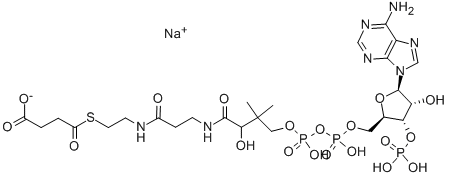
| Description | Succinyl-coenzyme A (succinyl-CoA) is an intermediate in the citric acid cycle. It is converted to succinate, which is a metabolic intermediate with various biological activities. Succinyl-CoA is required, with glycine, to form δ-aminolevulinic acid in the first step of porphyrin and heme synthesis. Succinyl-CoA deficiency, caused by vitamin B12 deficiency can disrupt heme and energy production, leading to neuromotor dysfunction. | | Uses | Succinyl coenzyme A sodium salt has been used: - for the nonenzymatic succinylation of lysine in vitro,
- as a substrate for adipic acid biosynthesis in recombinant E. coli
- in isocitrate dehydrogenase (ICDH)?treatment for the succinylation of proteins
- as a substrate to study the specificity and kinetics of enzymes such as acetate:succinate CoA-transferase and 5-aminolevulinate synthase (ALA synthase)
| | Biochem/physiol Actions | Succinyl CoA is an intermediate in the citric acid cycle. It is formed by α-ketoglutarate dehydrogenase by the decarboxylation of α-ketoglutarate. Succinyl CoA is also formed from propionyl CoA during the β-oxidation of odd-chain fatty acids. Succinyl CoA serves as a precursor in heme synthesis. It is also required for the oxidation of ketone bodies. | | Purification Methods | If it should be purified further, then it should be dissolved in H2O (0.05g/mL) adjusted to pH 1 with 2M H2SO4 and extracted several times with Et2O. Excess Et2O is removed from the aqueous layer by bubbling N2 through it and is stored frozen at pH 1. When required, the pH should be adjusted to 7 with dilute NaOH and used within 2 weeks (samples should be frozen). Succinyl coenzyme A is estimated by the hydroxamic acid method [Hersch & Jencks J Biol Chem 242 3468 1967]. It is more stable in acidic than in neutral aqueous solutions, but neutral solutions can be stored at –15o with negligible decomposition. [Jordan & Laghai-Newton Methods Enzymol 123 435 1986, Beilstein 26 III/IV 3666.] |
| SUCCINYL COENZYME A SODIUM SALT Preparation Products And Raw materials |
|


 日本语
日本语 한국어
한국어 Français
 Deutsch
 España
 Türkiye