Other grades of this product :
| DL-Mevalonolactone Basic information |
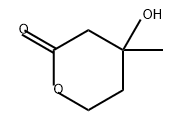
| Product Name: | DL-Mevalonolactone | | Synonyms: | DL-MEVALONOLACTONE;β-Hydroxy-β-methyl-δ-valerolactone, (±)-β-Hydroxy-β-methyl-δ-valerolactone, (±)-3-Hydroxy-3-methyl δ-valerolactone, (±)-Mevalolactone, (±)-Mevalonic acid lactone, (±)-Mevalonolactone;(4S)-4-Hydroxy-4-methyltetrahydro-2H-pyran-2-one;(S)-3,5-Dihydroxy-3-methylpentanoic acid δ-lactone;(S)-4β-Hydroxy-4-methyltetrahydro-2H-pyran-2-one;(S)-Tetrahydro-4-hydroxy-4-methyl-2H-pyran-2-one;Beta-Hydro;(±)-Mevalonolactone,(±)-β-Hydroxy-β-methyl-δ-valerolactone, (±)-3-Hydroxy-3-methyl δ-valerolactone, DL-Mevalolactone, DL-Mevalonic acid lactone | | CAS: | 674-26-0 | | MF: | C6H10O3 | | MW: | 130.14 | | EINECS: | 211-615-0 | | Product Categories: | Heterocycles, Metabolites & Impurities;Heterocycles;Metabolites & Impurities | | Mol File: | 674-26-0.mol |
| DL-Mevalonolactone Chemical Properties |
| Melting point | 28 °C(lit.) | | Boiling point | 145-150 °C5 mm Hg(lit.) | | alpha | -1.0~+1.0°(20℃/D)(c=5, C2H5OH) | | density | 1.1066 (rough estimate) | | refractive index | n20/D 1.473(lit.) | | Fp | >230 °F | | storage temp. | -20°C | | solubility | Chloroform (Sparingly), DMSO (Slightly), Ethyl Acetate, Methanol (Slightly) | | form | Oil | | pka | 13.57±0.20(Predicted) | | color | Pale Yellow to Dark Brown | | Merck | 14,6163 | | BRN | 80960 | | Stability: | Hygroscopic | | InChIKey | JYVXNLLUYHCIIH-UHFFFAOYSA-N | | CAS DataBase Reference | 674-26-0(CAS DataBase Reference) | | NIST Chemistry Reference | Dl-mevalonic acid lactone(674-26-0) |
| WGK Germany | 3 | | F | 3-10 | | HS Code | 29322090 |
| DL-Mevalonolactone Usage And Synthesis |
| Description | DL-Mevalonolactone is the δ-lactone form of mevalonic acid, a precursor in the mevalonate pathway. It induces depolarization and swelling, decreases NADPH content and aconitase (ACO) activity, and increases malondialdehyde (MDA) production in calcium-loaded rat brain mitochondria. DL-Mevalonolactone reverses decreases in glucose uptake induced by simvastatin (Item Nos. 10010344 | 10010345) in L6 myotubes. Tissue levels and urinary excretion of DL-mevalonolactone are increased in patients with mevalonic aciduria, a disorder characterized by a deficiency in mevalonic kinase activity. | | Chemical Properties | Pale Yellow Oil | | Uses | A metabolite from endophytes of the medicinal plant Erythrina crista-galli. | | Uses | HMG CoA substrate | | Uses | (±)-Mevalonolactone is used to:- study the effect of statin on the prenylation of Ras and Rho GTPases
- analyse the isoprenoid biosynthesis pathways in Listeria monocytogenes
- study the the effects of statins on proliferation and migration of HUVECs (HGF-induced human umbilical vein endothelial cells)
| | Synthesis Reference(s) | Journal of the American Chemical Society, 104, p. 5486, 1982 DOI: 10.1021/ja00384a040Synthesis, p. 719, 1974 DOI: 10.1055/s-1974-23416 | | General Description | Alkaline hydrolysis of mevalonolactone gives mevalonate. Mevalonate is a precursor of farnesyl and geranylgeranyl pyrophosphates. These pyrophosphates are required for protein prenylation. | | Purification Methods | Purify the lactone via the dibenzyl-ethylenediammonium salt (m 124-125o) [Hofmann et al. J Am Chem Soc 79 2316 1957], or by chromatography on paper or on a Dowex-1 (formate) column. [Bloch et al. J Biol Chem 234 2595 1959.] Store it as the N,N'-dibenzylethylenediamine (DBED) salt, or as the lactone in a sealed container at 0o. [Beilstein 18/1 V 19.] |
| DL-Mevalonolactone Preparation Products And Raw materials |
|


 日本语
日本语 한국어
한국어 Français
 Deutsch
 España
 Türkiye