Other grades of this product :
| Cloquintocet-mexyl Basic information |
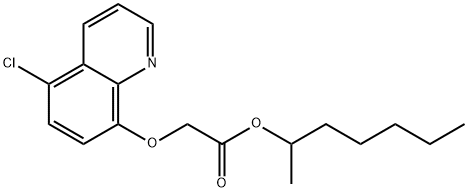
| Product Name: | Cloquintocet-mexyl | | Synonyms: | heptan-2-yl 2-((5-chloroquinolin-8-yl)oxy)acetate;Cloquintocet-1;Cloquintocet-methyl;CLOQUINTOCET MEXYL TECHNICAL (SAFNER) BA;UPH-203 S CLOQUINTOCET MEXYL (SAFENER)"WE INTEND TO CLAIM REWARDS UNDER MERCHANDISE EXPORTS FROM INDIA SCHEME (MEIS)";CLOQUINTOCET-MEXYL;CLOQUINTOCET-1-METHYLHEXYL ESTER;CLOQUINTOCET-MEXYL PESTANAL, 250 MG | | CAS: | 99607-70-2 | | MF: | C18H22ClNO3 | | MW: | 335.83 | | EINECS: | 619-447-3 | | Product Categories: | Alpha sort;C;CAlphabetic;CI - CL;Pesticides&Metabolites | | Mol File: | 99607-70-2.mol |
| Cloquintocet-mexyl Chemical Properties |
| Melting point | 69° | | Boiling point | 448.4±30.0 °C(Predicted) | | density | 1.163±0.06 g/cm3(Predicted) | | vapor pressure | 0-54.4Pa at 25-185.9℃ | | storage temp. | Sealed in dry,2-8°C | | solubility | Chloroform (Slightly), DMSO (Slightly), Ethyl Acetate (Slightly) | | form | neat | | pka | 1.94±0.29(Predicted) | | color | White to Off-White | | Merck | 14,2401 | | Stability: | Stable. Incompatible with strong oxidizing agents. | | LogP | 5.2-5.24 at 25℃ and pH5-9.1 | | Surface tension | 56.8-57.2mN/m at 590μg/L and 20℃ | | Dissociation constant | 3.55 at 20℃ | | CAS DataBase Reference | 99607-70-2(CAS DataBase Reference) | | EPA Substance Registry System | Cloquintocet-mexyl (99607-70-2) |
| Hazard Codes | Xi | | Risk Statements | 43 | | Safety Statements | 36/37 | | RIDADR | UN 3077 | | WGK Germany | 2 | | RTECS | AG1265000 | | Toxicity | LD50 in rats (mg/kg): >2000 orally; >2000 dermally; LC50 (4 hr) in rats: >935 mg/m3 by inhalation (Amrein) |
| Cloquintocet-mexyl Usage And Synthesis |
| Description | Cloquintocet-mexyl is a colourless crystalline herbicide safener. It is categorized as Class III toxin. | | Chemical Properties | beige solid | | Uses | Cloquintocet-mexyl is used as a herbicide. | | Uses | Cloquintocet-mexyl is a herbicide. It is used to control coarse annual grass of the family poaceae (gramineae). lt was developed by the swiss ciba geigy in the 1980s and the patent has expired. | | Agricultural Uses | Cloquintocet-mexyl is a safener that can be used in conjunction with various herbicides to reduce phytotoxicity to crops. Though effective as a safener, the manufacture, storage, and use of cloquintocet-mexyl containing products can present challenges owing to its sensitivity to water and its low melting temperature (i.e., 61-69° C. for technical material). When products containing cloquintocet-mexyl are prepared, stored, or used in the presence of water, cloquin tocet-mexyl can undergo hydrolysis to form cloquintocet acid, and/or form a needle-shaped, crystalline hydrate that can, lead to clogged spray nozzles during spray applications and/or possibly increased levels of crop phytotoxicity. | | Carcinogenicity | In accordance with the EPA Proposed EPA Weight-of-the-Evidence Categories, August 1999, the HIARC classified cloquintocet-mexyl as "not likely to be a human carcinogen." Carcinogenicity studies in rats and mice did not show increased incidence of spontaneous tumor formation. With negative mutagenic test battery, it is suggested that cloquintocet-mexyl (CGA 185072) is not likely to be a human carcinogen. | | Metabolism | Metabolism studies in rats indicated that approximately 40% of the administered dose of cloquintocet-mexyl was absorbed through the gastrointestinal tract and subsequently excreted via the urine. Fecal excretion accounted for approximately 60% of the administered dose. The chemical was rapidly eliminated (more than 80% of the administered dose) via feces and urine within 48 hours post-dosing. Sex, dosing regime, and dose levels had little effect on the excretion pattern. Excretion patterns were similar between the biliary cannulated and non-cannulated animals indicating that there was no enterohepatic circulation of the chemical. Three days after administration, tissue radioactivity accounted for less than 0.3% of the administered dose (or was non-detectable) and was not detectable in the expired air. At day three post-dosing, most tissue residues of radioactivity were below the limit of detection. The major metabolic pathway of cloquintocet-mexyl was ester hydrolysis to yield 5-chloro-8-quinolinoxy acetic acid, the major metabolite in the fecal and urinary pools. | | Toxicity evaluation | Cloquintocet-mexyl has a low order of acute oral, dermal, and inhalation toxicity. It is slightly irritating to the eyes and non-irritating to the skin. Cloquintocet-mexyl is a skin sensitizer. The chemical is not genotoxic and is not a reproductive and developmental toxicant. There is no evidence of neurotoxicity in the available studies. Cloquintocet-mexyl is classified as “not likely to be a human carcinogen.” The main metabolite for cloquintocet-mexyl is 5-chloro-8-quin-linoxyacetic acid, and testing on the metabolite is part of the toxicology database for cloquintocet-mexyl. |
| Cloquintocet-mexyl Preparation Products And Raw materials |
|


 日本语
日本语 한국어
한국어 Français
 Deutsch
 España
 Türkiye