Other grades of this product :
| 2',4',6'-Trihydroxyacetophenone monohydrate Basic information |
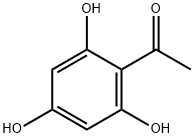
| Product Name: | 2',4',6'-Trihydroxyacetophenone monohydrate | | Synonyms: | 2',4',6'-Trihydroxyacetophenone monohydrate;2-Acetylphloroglucinol hydrate;Phloroacetophenone monohydrate;THAP;2',4',6'-Trihydroxyacetophenone (monohydrate/anhydrous);2',4',6'-Trihydroxyacetophenone hydrate, 98+%;1-(2,4,6-TRIHYDROXYPHENYL)-ETHANONE;2',4',6'-TRIHYDROXYACETOPHENONE | | CAS: | 480-66-0 | | MF: | C8H8O4 | | MW: | 168.15 | | EINECS: | 207-556-5 | | Product Categories: | Aromatic Acetophenones & Derivatives (substituted);Alcohols and Derivatives;Carbonyl Compounds;Analytical Chemistry;Building Blocks;Inhibitors;Mass Spectrometry;Aromatics;Intermediates & Fine Chemicals;Pharmaceuticals;C7 to C8;Chemical Synthesis;Ketones;Organic Building Blocks;Matrix Materials (MALDI-TOF-MS) | | Mol File: | 480-66-0.mol |
| 2',4',6'-Trihydroxyacetophenone monohydrate Chemical Properties |
| Melting point | 219-221 °C(lit.) | | Boiling point | 257.07°C (rough estimate) | | density | 1.3037 (rough estimate) | | refractive index | 1.5090 (estimate) | | storage temp. | Store below +30°C. | | solubility | DMSO (Sparingly), Ethanol (Slightly), Methanol (Slightly), Water (Very Slightly, | | pka | 7.76±0.23(Predicted) | | form | Powder | | color | light yellow | | Water Solubility | Soluble in water. | | BRN | 1911197 | | CAS DataBase Reference | 480-66-0(CAS DataBase Reference) | | NIST Chemistry Reference | Ethanone, 1-(2,4,6-trihydroxyphenyl)-(480-66-0) | | EPA Substance Registry System | Ethanone, 1-(2,4,6-trihydroxyphenyl)- (480-66-0) |
| Hazard Codes | Xi | | Risk Statements | 36/37/38 | | Safety Statements | 26-36-24/25 | | WGK Germany | 3 | | RTECS | AN0528000 | | TSCA | Yes | | HazardClass | IRRITANT | | HS Code | 29145000 |
| 2',4',6'-Trihydroxyacetophenone monohydrate Usage And Synthesis |
| Chemical Properties | Light Brown Solid | | Uses | Monoacetylphloroglucinol (MAPG) is small molecular weight phenolic metabolite belonging to the phloroglucinol (1,3,5-trihydroxybenzene) family, produced by bacteria including Pseudomonas strains. MAPG exhibits a broad range of biological activity albeit with mostly low potency. In the search for novel actives, MAPG and related metabolites are important metabolites for dereplication to eliminate leads due to high amounts of weakly potent actives. Although weakly active, this family appears to be important in the biocontrol of plant diseases by some Pseudomonas strains. | | Uses | Induced choleresis in rats is mediated through multidrug resistance protein-2 (Mrp2). It enhances bile secretion | | Uses | Induced choleresis in rats is mediated through multidrug resistance protein-2 (Mrp2). It enhances bile secretion. | | Preparation | Preparation by reaction of acetic anhydride on phloroglucinol,with concentrated sulfuric acid at 130° (70%)with boron trifluoride at 10° (62.5–68%) with zinc chloride at 145–150° (50%)with Amberlite IR-120 or Zeokarb 225 (cation exchange resins, sulfonic acid type) at 160° (39%). | | Definition | ChEBI: A benzenetriol that is acetophenone in which the hydrogens at positions 2, 4, and 6 on the phenyl group are replaced by hydroxy groups. It is used as a matrix in matrix-assisted laser desorption/ionization (MALDI) mass spectrometry for the analysis of acid
c glycans and glycopeptides. | | Biological Activity | monoacetylphloroglucinol (mapg), small molecular weight phenolic metabolite, is produced via bacteria including pseudomonas strains. mapg is acetylated to form the broad-spectrum antibiotic, 2,4-diacetylphloroglucinol (dapg) by mapg acetyltransferase. in addition, mapg exerts fairly weak potency when exhibiting a broad range of antibiotic activity. even though weakly active, it seems that mapg is essential in the biocontrol of plant diseases by some pseudomonas strains [1]. | | Purification Methods | Crystallise the ketone from hot H2O (35mL/g). [Beilstein 8 IV 2729.] | | references | [1]. hayashi, a., saitou, h., mori, t., matano, i., sugisaki, h., & maruyama, k. molecular and catalytic properties of monoacetylphloroglucinol acetyltransferase frompseudomonassp. ygj3. bioscience, biotechnology, and biochemistry. 2012; 76(3): 559-566. |
| 2',4',6'-Trihydroxyacetophenone monohydrate Preparation Products And Raw materials |
|


 日本语
日本语 한국어
한국어 Français
 Deutsch
 España
 Türkiye