Other grades of this product :
| (Trifluoromethyl)trimethylsilane Basic information |
| (Trifluoromethyl)trimethylsilane Chemical Properties |
| Boiling point | 54-55 °C (lit.) | | density | 0.962 g/mL at 20 °C (lit.) | | vapor pressure | 10.98 psi ( 55 °C) | | refractive index | n20/D 1.386 | | Fp | 14 °F | | storage temp. | 2-8°C | | solubility | sol THF, ether, CH2Cl2. | | form | Liquid | | color | Clear colorless | | Specific Gravity | 0.962 | | Water Solubility | Soluble in alcohol, THF, ether, dichloromethane, aromatic and aliphatic hydrocarbons. Soluble in water(with white smokes). | | Hydrolytic Sensitivity | 4: no reaction with water under neutral conditions | | Sensitive | Moisture Sensitive | | Merck | 14,9683 | | BRN | 4241868 | | Exposure limits | ACGIH: TWA 50 ppm; STEL 100 ppm (Skin)OSHA: TWA 200 ppm(590 mg/m3)NIOSH: IDLH 2000 ppm; TWA 200 ppm(590 mg/m3); STEL 250 ppm(735 mg/m3) | | InChIKey | MWKJTNBSKNUMFN-UHFFFAOYSA-N | | CAS DataBase Reference | 81290-20-2(CAS DataBase Reference) |
| (Trifluoromethyl)trimethylsilane Usage And Synthesis |
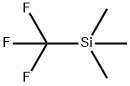
| Chemical Properties | (Trifluoromethyl)trimethylsilane (TMSCF3) is a flammable colorless liquid with a boiling point of 54–55 °C, a flash point of –17 °C and density of 0.926 g/mL at 20 °C. It is a trifluoromethylation reagent used in nucleophilic addition reactions of aldehydes and ketones. It may be harmful if inhaled, swallowed, absorbed through skin and may cause respiratory tract, skin and eye irritation. TMSCF3 was firstly synthesized by Rupert in 1984 via the condensation reaction of CF3Br and TMSCl with (Et2N)3P. | | Uses | TMSCF3 is versatile reagent for trifluoromethylation, such as transition-metal-catalyzed reaction, miscellaneous trifluoromethylation, and addition to carbonyl and imine groups. These reactions are extremely useful approaches in the pharmaceutical and agrochemical industry, because they enhance metabolic stability (metabolic blocking) and alter the compound properties (liphophilicity, binding selectivity). | | Uses | Silicon-based fluorinating reagents for the efficient trifluoromethylation of carbonyls and ethylene diamines. Precursors used for metal-mediated trifluoromethylation of aromatic, heteroaromatic, vinyl substrates, etc. | | Preparation | (Trifluoromethyl)trimethylsilane is prepared from trimethylsilyl chloride and bromotrifluoromethane in the presence of a phosphorus(III) reagent that serves as a halogen acceptor. | | General Description | Trimethyl(trifluoromethyl)silane (TMSCF3) is also called as Ruppert-Prakash fluorination reagent. It is extensively used for the synthesis of trifluoromethyl-containing compounds. | | Purification Methods | Purify it by distilling it from trap to trap in a vacuum of 20mm using a bath at 45o and Dry-ice/Me2CO bath for the trap. The liquid in the trap is then washed with ice cold H2O (3x), the top layer is collected, dried (Na2SO4), and the liquid is decanted and fractionated through a helices-packed column at atmospheric pressure. 1H, 1 3C, 1 9F, and 2 9Si NMR can be used for assessing the purity of fractions. [Ruppert et al. Tetrahedron Lett 25 2195 1984, Krishnamurti et al. J Org Chem 56 984 199, Beilstein 4 IV 3892.] |
| (Trifluoromethyl)trimethylsilane Preparation Products And Raw materials |
|


 日本语
日本语 한국어
한국어 Français
 Deutsch
 España
 Türkiye