Other grades of this product :
| Benzyl mercaptan Chemical Properties |
| Melting point | -29 °C | | Boiling point | 194-195 °C (lit.) | | density | 1.058 g/mL at 25 °C (lit.) | | vapor density | >4 (vs air) | | refractive index | n20/D 1.575(lit.) | | FEMA | 2147 | BENZYL MERCAPTAN | | Fp | 158 °F | | storage temp. | 2-8°C | | form | Liquid | | pka | 9.43(at 25℃) | | color | Clear colorless to light yellow | | explosive limit | 1%(V) | | Water Solubility | Not miscible or difficult to mix in water. | | Sensitive | Air Sensitive | | Merck | 14,9322 | | JECFA Number | 526 | | BRN | 605864 | | Stability: | Stable. Combustible. | | InChIKey | UENWRTRMUIOCKN-UHFFFAOYSA-N | | CAS DataBase Reference | 100-53-8(CAS DataBase Reference) | | NIST Chemistry Reference | Benzenemethanethiol(100-53-8) | | EPA Substance Registry System | Benzenemethanethiol (100-53-8) |
| Benzyl mercaptan Usage And Synthesis |
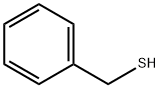
| Description | Benzyl mercaptan (C6H5CH2SH) is a kind of organosulfur compound. It is a commonly used alkaylthiol in the laboratory and is a naturally occurring compound. It has been found in boxwood and boost the smoky aroma in some kinds of wines. It is also naturally existed in coffee. It can be used as source of thiol functional group during the organic synthesis. In addition, it can also used as an odorant, synthetic flavor and as a bacteriostatic reagent. It is manufactured by the reaction of benzyl chloride and sodium hydrosulfide.
| | Chemical Properties | Cream to white, moist crystals; musty
odor. Insoluble in water; soluble in alcohol
or ether. There are three isomers with different
boiling points. | | Chemical Properties | Benzyl mercaptan has repulsive, garlic-like odor. It oxidizes in air to dibenzyl disulfide. | | Occurrence | Reported found in coffee. | | Uses | Intermediate, bacteriostat. | | Uses | Benzyl mercaptan can be used as:- A nucleophilic reagent in the cleavage of proanthocyanidins into their constitutive subunits.
- A reactant in the synthesis of dithiocarboxylic esters in the presence of phosphorus pentasulfide as a catalyst.
- A modifier to functionalize the surface of CNT for enhanced interaction with Pt-nanoparticles.
| | Preparation | From benzyl chloride and potassium hydrosulfide. | | Aroma threshold values | Detection: 0.19 to 2.6 ppb. | | Taste threshold values | Taste characteristics at 15 ppm: leek, horseradish, cabbage, green, tomato and coffee. | | Synthesis Reference(s) | Canadian Journal of Chemistry, 53, p. 1480, 1975 DOI: 10.1139/v75-205Synthesis, p. 498, 1984 DOI: 10.1055/s-1984-30880 | | Hazard | Skin irritant. | | Safety Profile | Poison by inhalation
and intraperitoneal routes. Moderately toxic
by ingestion. An eye irritant. Questionable
carcinogen with experimental tumorigenic
data. Flammable when exposed to heat or
flame. Can react vigorously with oxidizing
materials. To fight fire, use foam, CO2, dry
chemical, water spray, mist, fog. When
heated to decomposition and on contact
with acid or acid fumes it emits highly toxic
fumes of SOx. See also SULFIDES and
MERCAPTANS. | | Purification Methods | Purify benzyl mercaptan via the mercury salt [see Kern J Am Chem Soc 75 1865 1953], which crystallises from *benzene as needles (m 121o), and then dissolve it in CHCl3. Pass H2S gas through the solution to regenerate the mercaptan. The HgS that precipitates is filtered off and washed thoroughly with CHCl3. The filtrate and washings are evaporated to remove CHCl3; then the residue is fractionally distilled under reduced pressure [Mackle & McClean, Trans Faraday Soc 58 895 1962]. [Beilstein 6 IV 2632.] |
| Benzyl mercaptan Preparation Products And Raw materials |
|


 日本语
日本语 한국어
한국어 Français
 Deutsch
 España
 Türkiye