Other grades of this product :
| DINOBUTON Basic information |
| DINOBUTON Chemical Properties |
| Melting point | 61-62℃ | | Boiling point | 464.35°C (rough estimate) | | density | 1.2731 (rough estimate) | | refractive index | 1.5110 (estimate) | | form | neat | | Water Solubility | Insoluble in water | | Merck | 13,3315 | | BRN | 2065340 | | CAS DataBase Reference | 973-21-7 | | EPA Substance Registry System | Dinobuton (973-21-7) |
| DINOBUTON Usage And Synthesis |
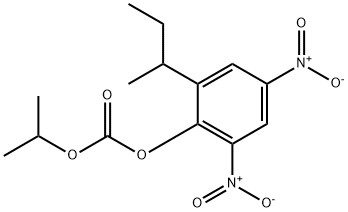
| Uses | Miticide. | | Uses | Dinobuton is a non-systemic fungicide, active against powdery
mildews in apples, cotton and vegetables. | | Metabolic pathway | Dinobuton is metabolised in plants and animals via common metabolic
pathways. The primary reaction is hydrolytic cleavage of the
carbonate-dinitrophenyl linkage to yield dinoseb. Further reduction of
the nitro-groups of dinoseb yields the corresponding monoamino and
diamino analogues. Acetylation and deamination via hydroxylation/
elimination, and oxidation of the sec-butyl moiety also occurred. N- and
O-Conjugation as glucosides and glucuronides occurred in both plants
and animals. The metabolic pathways of dinobuton are presented in
Scheme 1. | | Degradation | There is limited information on the hydrolytic stability of dinobuton (1).
Marchenko and Vakulenko (1983) reported that the hydrolysis DT50 values
of dinobuton in pH 2, 7 and 11 buffer solutions at 22 °C were 15 days,
17 days and 4 hours, respectively. In vitro studies showed the rapid
hydrolysis of dinobuton to dinoseb [ 2-sec-butyl-4,6-dinitrophenol (2)] by
tissue homogenates of spider mites and animal tissues. Once generated,
dinoseb was stable to hydrolytic and photolytic degradation under acidic
condition but was readily degraded under alkaline conditions (Brestkin
et al., 1978; Molnar, 1935). Uncharacterised complex polar materials
were reported as photodecomposition products of dinoseb (Matsuo and
Casida, 1970). Grechko et al. (1986) reported that the DTW for dinobuton
in aqueous solution under UV light irradiation (365 nm) was <30 min. |
| DINOBUTON Preparation Products And Raw materials |
|


 日本语
日本语 한국어
한국어 Français
 Deutsch
 España
 Türkiye