Other grades of this product :
| Bromfenac sodium Basic information |
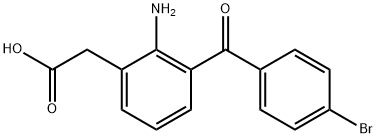
| Product Name: | Bromfenac sodium | | Synonyms: | BROMFENAC;2-Amino-3-(4-bromobenzoyl)benzeneacetic acid;Bromofenac;Benzeneacetic acid, 2-amino-3-(4-bromobenzoyl)-;Bromfenaco;Bromfenaco [spanish];Bromfenacum;Bromfenacum [latin] | | CAS: | 91714-94-2 | | MF: | C15H12BrNO3 | | MW: | 334.16 | | EINECS: | | Product Categories: | Miscellaneous | | Mol File: | 91714-94-2.mol |
| Bromfenac sodium Chemical Properties |
| Boiling point | 562.2±50.0 °C(Predicted) | | density | 1.565±0.06 g/cm3(Predicted) | | storage temp. | under inert gas (nitrogen or Argon) at 2–8 °C | | pka | 4.07±0.10(Predicted) |
| Bromfenac sodium Usage And Synthesis |
| Originator | Duract,Wyeth-Ayerst | | Uses | Analgesic. | | Uses | Bromfenac (Xibrom, ISTA Pharmaceuticals, Irvine, USA; Bronuck, Senju Pharmaceutical, Osaka, Japan) is indicated for the treatment of postoperative inflammation and the reduction of ocular pain in patients after undergoing cataract extraction. For this task, one drop of Xibrom may be applied to the affected eye twice daily beginning 24 hours after cataract surgery and continuing for the first 2 weeks of the postoperative period. The clinical safety and efficacy of bromfenac have been extensively studied in diverse comparative investigations, including the treatment of external or anterior ocular inflammatory diseases, allergic conjunctivitis, scleritis, and postoperative inflammation.The results of two phase III multicenter, randomized double-masked placebo-controlled clinical trials showed that bromfenac ophthalmic solution 0.09% was effective in the rapid resolution of ocular pain after cataract surgery, and there was a statistically significant difference between the bromfenac and placebo groups demonstrated in these phase III clinical trials. | | Definition | ChEBI: Amfenac in which the the hydrogen at the 4 position of the benzoyl group is substituted by bromine. It is used for the management of ocular pain and treatment of postoperative inflammation in patients who have undergone cataract extraction. It was withdraw
from the US market in 1998, following concerns over off-label abuse and hepatic failure. | | Manufacturing Process | Reaction of (2-aminophenyl)-(4-bromophenyl)-methanone with
methylsulfanylacetic acid ethyl ester and tert-butyl hypochlorite gives a
corresponding sulfonium salt. This salt was transformed to initially to the
betaine. Electrocyclic rearrangement of that transient intermediate leads, after
rearomatization, to the homoanthranilic acid. Internal ester-amine interchange
leads then to 4-bromophenyl-(3-(methylthio)indolin-7-yl)methanone. The
thiomethyl group is then removed with Raney nickel to give 4-bromophenyl-
(indolin-7-yl)methanone. Saponification of this intermediate affords the (2-
amino-3-(4-bromobenzoyl)-phenyl)-acetic acid (Bromfenac).
In practice it is usually used as sodium salt. | | Brand name | Xibrom
(Ista). | | Therapeutic Function | Analgesicá Antiinflammatory | | Veterinary Drugs and Treatments | Bromfenac is a nonsteroidal anti-inflammatory drug (NSAID) by
virtue of its ability to block prostaglandin synthesis by inhibiting
cyclooxygenase 1 and 2. Bromfenac is indicated for treatment of
postoperative inflammation in patients who have undergone cataract
extraction. |
| Bromfenac sodium Preparation Products And Raw materials |
|


 日本语
日本语 한국어
한국어 Français
 Deutsch
 España
 Türkiye