Other grades of this product :
| Hydrocortisone acetate Chemical Properties |
| Melting point | 223 °C (dec.)(lit.) | | Boiling point | 446.1°C (rough estimate) | | alpha | D25 +166° (c = 0.4 in dioxane); D25 +150.7° (c = 0.5 in acetone) | | density | d420 1.289 | | refractive index | 1.4593 (estimate) | | Fp | 223°C | | storage temp. | 0-6°C | | solubility | Practically insoluble in water, slightly soluble in anhydrous ethanol and in methylene chloride | | pka | 12.42±0.70(Predicted) | | form | Solid | | color | White to Off-White | | Water Solubility | Insoluble in water. | | Decomposition | 223 ºC | | Merck | 14,4787 | | BRN | 2066841 | | Stability: | Stable, but may be light or moisture sensitive. Incompatible with strong oxidizing agents. | | CAS DataBase Reference | 50-03-3(CAS DataBase Reference) | | NIST Chemistry Reference | Hydrocortisone acetate(50-03-3) |
| Hazard Codes | Xn,T | | Risk Statements | 63-10-45 | | Safety Statements | 36/37-45-53 | | WGK Germany | 3 | | RTECS | GM8960000 | | HS Code | 29372100 | | Toxicity | LD50 intraperitoneal in mouse: 2300mg/kg |
| Hydrocortisone acetate Usage And Synthesis |
| Adrenocorticotropic hormone drugs | Hydrocortisone acetate is an adrenal hormone drugs, white crystalline powder, odorless, bitter taste. The melting point is 216~222 ℃, right optical. Slightly soluble in ethanol, ether, chloroform, acetone, insoluble in water. It was synthesized by In 17α-hydroxy progesterone.
Hydrocortisone acetate has important physiological activities such as anti-inflammatory, anti-viral, anti-allergic, anti-shock, reducing inflammatory exudation effect, commonly used in clinical adrenal insufficiency and autoimmune diseases. Preparations are injection, tablets, ointments and eye drops. Adding a small amount of hydrocortisone acetate in some cosmetics cortisol can increase the efficacy of anti-allergy and improve the degree of whitening of the skin, but long-term using of such substances can cause the skin produce hormone-dependent disease. Our cosmetics cosmetics specifications prescribedthathormone substances can not be added.
| | Indications | For allergic, non-infectious skin diseases and a number of proliferative skin disorders. Such as dermatitis, eczema, neurodermatitis, seborrheic dermatitis and itching psychosis.
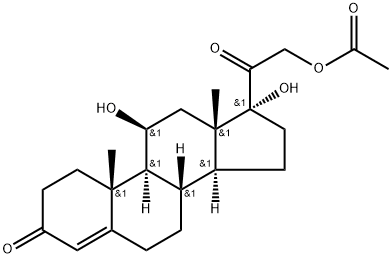
Figure 1 the chemical structure formula of tetra-fluoroethane.
| | Contraindications | 1. This medicine and matrix components allergy and allergic to other glucocorticoids are prohibited.
2. The primary bacterial, fungal and viral infectious skin diseases such as disabledare prohibited.
The above information is edited by the chemicalbook of KuiMing.
| | Adverse Reactions | Long-term using can cause local skin atrophy, telangiectasia, pigmentation, folliculitis, perioral dermatitis and secondary infection.
| | Precautions | 1. Not long-term, large-scale use.
2. The coated parts such as a burning sensation, itching, swelling, etc., should stop the medication.
| | Chemical Property | White or almost white crystalline powder, odorless. Mp218-221.5 ℃; 25D + 166 ° (dioxane) Specific rotation [α]; ethanol maximum absorption at 240nm wavelength. Insoluble in water, slightly soluble in ethanol (1: 230) and chloroform (1: 150), insoluble in ether.
| | Uses | Corticosteroid drugs, have anti-inflammatory, anti-allergic, anti-toxins, anti-shock effect.
| | Production methods | Hydrocortisone and acetic anhydride in pyridine esterification.
| | Chemical Properties | white powder | | Uses | Glucocorticoid | | Uses | Hydrocortisone acetate is used to treat hemorrhoids and itching/swelling in the rectum and anus. It is used to treat certain intestinal problems (such as ulcerative colitis of the rectum and other rectal/anal inflammatory conditions). | | Brand name | Cortef
Acetate (Pharmacia & Upjohn); Cortifoam (Schwarz
Pharma); Cortril (Pfizer); Dricort (Ingram); Hydrocortone
(Merck). | | Clinical Use | Corticosteroid:
Local inflammation of joints and soft tissue | | Drug interactions | Potentially hazardous interactions with other drugs
Aldesleukin: avoid concomitant use.
Antibacterials: metabolism accelerated by rifampicin;
metabolism possibly inhibited by erythromycin;
concentration of isoniazid possibly reduced.
Anticoagulants: efficacy of coumarins and
phenindione may be altered.
Antiepileptics: metabolism accelerated by
carbamazepine, phenobarbital, fosphenytoin,
phenytoin and primidone.
Antifungals: increased risk of hypokalaemia with
amphotericin - avoid; metabolism possibly inhibited
by itraconazole and ketoconazole.
Antivirals: concentration possibly increased by
ritonavir.
Ciclosporin: rare reports of convulsions in patients
on ciclosporin and high-dose corticosteroids.
Cobicistat: concentration of hydrocortisone possibly
increased - increased risk of adrenal suppression.
Diuretics: enhanced hypokalaemic effects of
acetazolamide, loop diuretics and thiazide diuretics.
Vaccines: high dose corticosteroids can impair
immune response to vaccines - avoid concomitant
use with live vaccines. | | Metabolism | Hydrocortisone is metabolised in the liver and most
body tissues to hydrogenated and degraded forms such as
tetrahydrocortisone and tetrahydrocortisol.
These are excreted in the urine, mainly conjugated as
glucuronides, with a very small proportion of unchanged
hydrocortisone. | | Purification Methods | The acetate recrystallises from Me2CO/Et2O or aqueous Me2CO as hygroscopic monoclinic crystals. UV has max at 242 nm (A1cm 1% 390) in MeOH. Its solubility at 25o is: H2O (0.001%), EtOH (0.45%), MeOH (0.04%), Me2CO (1.1%), CHCl3 (0.5%), Et2O (0.15%), and it is very soluble in Me2NCHO. [Wendler et al. J Am Chem Soc 74 3630 1952; Antonucci et al. J Org Chem 18 7081 1953, Beilstein 8 IV 3424.] |
| Hydrocortisone acetate Preparation Products And Raw materials |
|


 日本语
日本语 한국어
한국어 Français
 Deutsch
 España
 Türkiye