Other grades of this product :
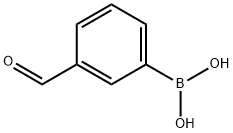
| 3-Formylphenylboronic acid Basic information |
| 3-Formylphenylboronic acid Chemical Properties |
| Melting point | 109-113 °C | | Boiling point | 354.4±44.0 °C(Predicted) | | density | 1.24±0.1 g/cm3(Predicted) | | storage temp. | Inert atmosphere,2-8°C | | solubility | soluble in Methanol | | pka | 7.83±0.10(Predicted) | | form | Powder, Crystals, and/or Chunks | | color | Off-white to beige or light orange | | Sensitive | Air Sensitive | | BRN | 3030769 | | CAS DataBase Reference | 87199-16-4(CAS DataBase Reference) |
| Hazard Codes | C,Xi | | Risk Statements | 34-36/37/38 | | Safety Statements | 22-26-36/37/39-45-37/39-27 | | RIDADR | UN 3261 8/PG 3 | | WGK Germany | 3 | | Hazard Note | Irritant | | HazardClass | IRRITANT, MOISTURE SENSITIVE | | PackingGroup | Ⅲ | | HS Code | 29319090 |
| 3-Formylphenylboronic acid Usage And Synthesis |
| Chemical Properties | Off-white Cryst | | Uses | 3-Formylphenylboronic acid can be used as reagent to study the effects of boronic acid on fluoride-selective chemosignaling behavior of merocyanine dye and as exciton-coupled CD probes for epigallocatechin gallate Biological inhibitor of γ-glutamyltranspeptidase.
| | Uses | suzuki reaction | | Uses | Reagent used: - To study the effects of boronic acid on fluoride-selective chemosignaling behavior of merocyanine dye
- As exciton-coupled CD probes for epigallocatechin gallate
Biological inhibitor of γ-glutamyltranspeptidaseReactant involved in: - Palladium-catalyzed homocoupling
- Suzuki coupling reactions
|
| 3-Formylphenylboronic acid Preparation Products And Raw materials |
|


 日本语
日本语 한국어
한국어 Français
 Deutsch
 España
 Türkiye