Other grades of this product :
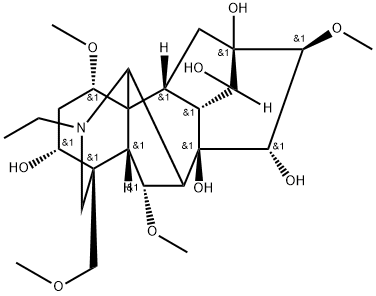
| Product Name: | ACONINE | | Synonyms: | ACONINE;(15S,16S)-20-Ethyl-1α,6α,16-trimethoxy-4-(methoxymethyl)aconitane-3α,8β,13β,14α,15-pentol;20-Ethyl-1α,6α,16β-trimethoxy-4-(methoxymethyl)aconitane-3α,8,13,14α,15α-pentol;(1alpha,3alpha,6alpha,14alpha,15alpha,16beta)-20-Ethyl-1,6,16-trimethoxy-4-(methoxymethyl)aconitane-3,8,13,14,15-pentol;Jesaconine;Aconitane-3,8,13,14,15-pentol,20-ethyl-1,6,16-trimethoxy-4-(methoxymethyl)-, (1a,3a,6a,14a,15a,16b)-;Aconine (Jesaconine);Aconitane-3,8,13,14,15-pentol, 20-ethyl-1,6,16-trimethoxy-4-(methoxymethyl)-, (1α,3α,6α,14α,15α,16β)- | | CAS: | 509-20-6 | | MF: | C25H41NO9 | | MW: | 499.6 | | EINECS: | | Product Categories: | Alkaloids;chemical reagent;pharmaceutical intermediate;phytochemical;reference standards from Chinese medicinal herbs (TCM).;standardized herbal extract | | Mol File: | 509-20-6.mol |
| ACONINE Chemical Properties |
| Melting point | 129-131℃ | | alpha | D +23° | | Boiling point | 590.79°C (rough estimate) | | density | 1.42 | | refractive index | 1.6000 (estimate) | | storage temp. | -20°C Freezer | | solubility | Chloroform (Slightly), DMSO (Slightly) | | pka | 9.52(at 25℃) | | form | Solid | | color | Off-White to Pale Yellow |
| ACONINE Usage And Synthesis |
| Toxicity | In vivo, aconine is toxic to mice when administered intravenously at a dose of 120 mg/kg. It induces flaccid paralysis and toxicity in rats with toxic dose (TD50) and LD50 values of 1.5 and 1.7 μmol per animal, respectively.
| | Description | Aconine is an alkaloid originally isolated from Aconitum species and active metabolite of aconitine. It inhibits osteoclast differentiation of RANKL-stimulated RAW 264.7 cells and bone resorption in a pit formation assay in a concentration-dependent manner. Aconine also inhibits RANKL-induced activation of NF-κB and NFATc1 in RAW 264.7 cells.
| | Description | Aconine is an alkaloid originally isolated from Aconitum species and active metabolite of aconitine. It inhibits osteoclast differentiation of RANKL-stimulated RAW 264.7 cells and bone resorption in a pit formation assay in a concentration-dependent manner. Aconine also inhibits RANKL-induced activation of NF-κB and NFATc1 in RAW 264.7 cells. In vivo, aconine is toxic to mice when administered intravenously at a dose of 120 mg/kg. It induces flaccid paralysis and toxicity in rats with toxic dose (TD50) and LD50 values of 1.5 and 1.7 μmol per animal, respectively. | | Uses | Aconine is a derivative of Aconitine (A189875), a neurotoxin which activates tetrodotoxin-sensitive Na+ channels, inducing presynaptic depolarization, thus blocking the nerve action potential which, in turn, blocks the release of neurotransmitters and decreases the end plate potential at the neuromuscular junction. |
| ACONINE Preparation Products And Raw materials |
|


 日本语
日本语 한국어
한국어 Français
 Deutsch
 España
 Türkiye