Other grades of this product :
| 2,6-Pyridinedicarboxylic acid chloride Basic information |
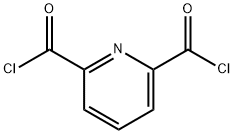
| Product Name: | 2,6-Pyridinedicarboxylic acid chloride | | Synonyms: | PYRIDINE-2,6-DICARBONYL CHLORIDE;PYRIDINE-2,6-DICARBOXYLIC ACID CHLORIDE;2,6-PYRIDINEDICARBONYL DICHLORIDE;2,6-PYRIDINEDICARBOXYLIC ACID CHLORIDE;(S)-(-)-1-(4-METHOXYPHENYL)ETHANOL;2,6-Pyridinedicarbonyl chloride, Pyridine-2,6-dicarboxylic acid chloride;2,6-Bis(chlorocarbonyl)pyridine;2,6-Pyridinedicarbonyl dichloride ,97% | | CAS: | 3739-94-4 | | MF: | C7H3Cl2NO2 | | MW: | 204.01 | | EINECS: | 223-125-4 | | Product Categories: | | Mol File: | 3739-94-4.mol |
| 2,6-Pyridinedicarboxylic acid chloride Chemical Properties |
| Melting point | 56-58 °C (lit.) | | Boiling point | 284 °C (lit.) | | density | 1.4521 (rough estimate) | | refractive index | 1.6100 (estimate) | | Fp | 284°C | | pka | -2.12±0.10(Predicted) | | form | Crystalline Powder, Crystals or Chunks | | color | White to brown | | Water Solubility | Insoluble in water. | | Sensitive | Moisture Sensitive | | BRN | 131556 | | CAS DataBase Reference | 3739-94-4(CAS DataBase Reference) | | NIST Chemistry Reference | 2,6-Pyridinedicarbony chloride(3739-94-4) |
| Hazard Codes | C | | Risk Statements | 34 | | Safety Statements | 26-36/37/39-45-24/25 | | RIDADR | UN 3261 8/PG 2 | | WGK Germany | 3 | | F | 10-19-21 | | HazardClass | 8 | | PackingGroup | II | | HS Code | 29333990 |
| 2,6-Pyridinedicarboxylic acid chloride Usage And Synthesis |
| Chemical Properties | white to brown crystalline powder, crystals or | | Uses | 2,6-Pyridinedicarboxylic acid chloride was used as the reagent during the synthesis of pyridine-based polyamido-polyester optically active macrocycles. It was used as starting reagent during the synthesis of pyridine-bridged 2,6-bis-carboxamide Schiff′s bases. It was used in the synthesis of N,N′-bis(1-pyrenylmethyl)pyridine-2,6-dicarboxamide.
| | Uses | 2,6-Pyridinedicarbonyl dichloride can be used as a starting material to synthesize: - Pyridine-based polyamido-polyester optically active macrocycles by reacting with chiral diamine dihydrobromides.
- Pyridine-bridged 2,6-bis-carboxamide Schiff′s bases by treating with L-alanine or 2-methyl-alanine methyl esters.
- N,N′-bis(1-pyrenylmethyl)pyridine-2,6-dicarboxamide by reacting with 1-pyrenemethylamine hydrochloride in the presence of a base.
| | Synthesis | Pyridine-2,6-dicarboxylic acid (105 mg, 0.52 mmol) mixed with 7mL of thionyl
chloride was heated to reflux for 3 hours. After the excess thionyl chloride was
removed, a white solid was obtained and used for the following synthesis without
further purifications. |
| 2,6-Pyridinedicarboxylic acid chloride Preparation Products And Raw materials |
|


 日本语
日本语 한국어
한국어 Français
 Deutsch
 España
 Türkiye