Other grades of this product :
| 3-Chloropivaloyl chloride Basic information |
| 3-Chloropivaloyl chloride Chemical Properties |
| 3-Chloropivaloyl chloride Usage And Synthesis |
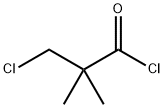
| Chemical Properties | clear colorless to light yellow-brown liquid | | Uses | 3-Chloropivaloyl Chloride is useful in the synthesis of compounds with antimicrobial and antioxidant activities. | | General Description | A colorless liquid. Very toxic by ingestion, inhalation and skin absorption. Flash point near 70°F. Corrosive. Contact may severely irritate skin, eyes, and mucous membranes. Used to make other chemicals. | | Air & Water Reactions | Highly flammable. Slightly soluble in water and less dense than water. Hence floats on water. Reacts with water to form hydrochloric acid (hydrogen chloride). | | Reactivity Profile | 3-Chloropivaloyl chloride is incompatible with strong oxidizing agents, alcohols, bases, including amines. May react vigorously or explosively if mixed with diisopropyl ether or other ethers in the presence of trace amounts of metal salts [J. Haz. Mat., 1981, 4, 291]. | | Health Hazard | TOXIC; inhalation, ingestion or contact (skin, eyes) with vapors, dusts or substance may cause severe injury, burns or death. Contact with molten substance may cause severe burns to skin and eyes. Reaction with water or moist air will release toxic, corrosive or flammable gases. Reaction with water may generate much heat that will increase the concentration of fumes in the air. Fire will produce irritating, corrosive and/or toxic gases. Runoff from fire control or dilution water may be corrosive and/or toxic and cause pollution. | | Fire Hazard | Combustible material: may burn but does not ignite readily. Substance will react with water (some violently) releasing flammable, toxic or corrosive gases and runoff. When heated, vapors may form explosive mixtures with air: indoors, outdoors and sewers explosion hazards. Most vapors are heavier than air. They will spread along ground and collect in low or confined areas (sewers, basements, tanks). Vapors may travel to source of ignition and flash back. Contact with metals may evolve flammable hydrogen gas. Containers may explode when heated or if contaminated with water. |
| 3-Chloropivaloyl chloride Preparation Products And Raw materials |
|


 日本语
日本语 한국어
한국어 Français
 Deutsch
 España
 Türkiye