Other grades of this product :
| Tributyltin chloride Chemical Properties |
| Melting point | -9 °C | | Boiling point | 171-173 °C25 mm Hg(lit.) | | density | 1.2 g/mL at 25 °C(lit.) | | vapor pressure | <0.01 mm Hg ( 20 °C) | | refractive index | n20/D 1.492(lit.) | | Fp | >230 °F | | storage temp. | 2-8°C | | solubility | 0.017g/l | | form | liquid | | Specific Gravity | 1.186 | | color | colorless | | Water Solubility | PRACTICALLY INSOLUBLE | | Sensitive | Moisture Sensitive | | BRN | 3535715 | | Exposure limits | ACGIH: TWA 0.1 mg/m3; STEL 0.2 mg/m3 (Skin)NIOSH: IDLH 25 mg/m3; TWA 0.1 mg/m3 | | InChIKey | GCTFWCDSFPMHHS-UHFFFAOYSA-M | | LogP | 2.21 at 23℃ | | CAS DataBase Reference | 1461-22-9(CAS DataBase Reference) | | NIST Chemistry Reference | Tri-n-butyltin chloride(1461-22-9) | | EPA Substance Registry System | Tributyltin chloride (1461-22-9) |
| Tributyltin chloride Usage And Synthesis |
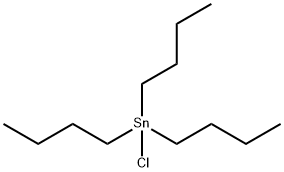
| Description | Tributyltin chloride is also as Chlorotributyltin, is the chloride of tributyltin. It is a biocide that contaminates foods, especially shellfish. It is an endocrine disrupter in several marine species and is neurotoxic and immuno-toxic in mammals. It has been used as a heat stabilizer, agricultural pesticide and component of antifouling paints2. However, it is perhaps the most acutely toxic chemical to aquatic organisms ever deliberately introduced to water. It has been demonstrated to have an adverse effect on shellfish in France and England, and as a consequence the use of tributyltin‐containing antifouling paints has been restricted in these countries. Other countries have banned the use of tributyltin‐containing antifouling paints or are contemplating restrictions3. | | References |
- Cooke, G. M., et al. Food & Chemical Toxicology An International Journal Published for the British Industrial Biological Research Association 42.2(2004):211-220.
- Nakatsu, Yusuke, Y. Kotake, and S. Ohta. "Tributyltin-induced cell death is mediated by calpain in PC12 cells."Neurotoxicology 27.4(2006):587-593.
- Maguire, R. James. "Environmental aspects of tributyltin." Applied Organometallic Chemistry 1.6(1987):475-498.
| | Chemical Properties | Colorless or light yellow clear liquid. Soluble in the common organic solvents; including alcohol, heptane, benzene, and toluene; insoluble in cold water, but hydrolyzes in hot water. | | Uses | Tributyltin Chloride is a triorganotin compound with insecticidal acitivity. It is an endocrine disruptor as well as an inhibitor for the V-ATPases (potential targets in the treatmen t of diseases such as osteoporosis and cancer). Tributyltin Chloride has the functions of antiseptic, sterilization and mildew proof and widely used in wood preservation, ship paint, etc. Further, it is used in hot end glass coating and rodent-repellent for cable coatings. | | Preparation | Tributyltin chloride is prepared by a redistribution reaction by combining stannic chloride and tetrabutyltin:
3 (C4H9)4Sn + SnCl4 → 4 (C4H9)3SnCl. | | Hazard | A poison by ingestion and skin contact.
A severe eye irritant. Tributyl tin compounds are
extremely toxic to marine life. | | Flammability and Explosibility | Notclassified |
| Tributyltin chloride Preparation Products And Raw materials |
|


 日本语
日本语 한국어
한국어 Français
 Deutsch
 España
 Türkiye