Other grades of this product :
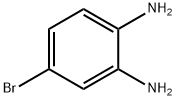
| 4-Bromo-1,2-benzenediamine Basic information |
| 4-Bromo-1,2-benzenediamine Chemical Properties |
| Melting point | 65-69 °C (dec.)(lit.) | | Boiling point | 289.3±20.0 °C(Predicted) | | density | 1.697±0.06 g/cm3(Predicted) | | storage temp. | Keep in dark place,Sealed in dry,Room Temperature | | solubility | Soluble in chloroform. | | pka | 3.46±0.10(Predicted) | | form | powder to crystal | | color | White to Brown | | InChIKey | WIHHVKUARKTSBU-UHFFFAOYSA-N | | CAS DataBase Reference | 1575-37-7(CAS DataBase Reference) |
| Hazard Codes | T | | Risk Statements | 25-36/38-43 | | Safety Statements | 26-36/37-45 | | RIDADR | UN 2811 6.1/PG 3 | | WGK Germany | 3 | | Hazard Note | Toxic | | HazardClass | 6.1 | | PackingGroup | III | | HS Code | 29215110 |
| 4-Bromo-1,2-benzenediamine Usage And Synthesis |
| Chemical Properties | White solid | | Uses | 4-Bromo-o-phenylenediamine, is used as an important raw material and intermediate used in organic Synthesis, pharmaceuticals, agrochemicals and dyestuff. | | Uses | 4-Bromo-1,2-diaminobenzene can be used as a precursor for preparing fluorescent dipolar quinoxaline derivatives, which can find applications as potential emissive and electron-transport materials. It can also be used in the synthesis of 6-bromo-2-methylbenzimidazole. | | General Description | 4-Bromo-1,2-diaminobenzene can be obtained from 1,2-diaminobenzene via acetylation followed by bromination and alkaline hydrolysis. |
| 4-Bromo-1,2-benzenediamine Preparation Products And Raw materials |
|


 日本语
日本语 한국어
한국어 Français
 Deutsch
 España
 Türkiye