Other grades of this product :
| 2,6-DIMETHYL-2,5-HEPTADIEN-4-ONE Basic information |
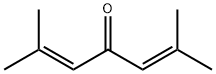
| Product Name: | 2,6-DIMETHYL-2,5-HEPTADIEN-4-ONE | | Synonyms: | diisopropylidineacetone;Foron;Phoron;s-Diisopropylidene acetone;DIISOPROPYLIDENEACETONE;2,6-DIMETHYL-2,5-HEPTADIEN-4-ONE;2,6-DIMETHYL-2,5-HEPTADIENE-4-ONE;SYM-DIISOPROPYLIDENEACETONE | | CAS: | 504-20-1 | | MF: | C9H14O | | MW: | 138.21 | | EINECS: | 207-986-3 | | Product Categories: | | Mol File: | 504-20-1.mol |
| 2,6-DIMETHYL-2,5-HEPTADIEN-4-ONE Chemical Properties |
| Melting point | 23-26 °C(lit.) | | Boiling point | 198-199 °C(lit.) | | density | 0.885 g/mL at 25 °C(lit.) | | vapor density | 4.8 (vs air) | | vapor pressure | 0.38 mm Hg ( 20 °C) | | refractive index | n20/D 1.497(lit.) | | Fp | 175 °F | | storage temp. | 2-8°C | | solubility | Chloroform (Slightly), Methanol (Slightly) | | form | Solid | | color | Light Yellow to Yellow Oil to Low-Melting | | Merck | 7333 | | CAS DataBase Reference | 504-20-1(CAS DataBase Reference) | | EPA Substance Registry System | Phorone (504-20-1) |
| WGK Germany | 3 | | RTECS | MI5500000 | | HS Code | 2914199090 |
| 2,6-DIMETHYL-2,5-HEPTADIEN-4-ONE Usage And Synthesis |
| Chemical Properties | Yellow liquid or yellow green prismatic crystal | | Uses | Diisopropylidene Acetone is a reagent used in the preparation of biaryls by Suzuki-Miyaura cross coupling reaction. | | General Description | A yellowish liquid with a solvent-like odor. Density 7.3 lb / gal. Very low vapor pressure (0.38 mm Hg at 68°F). Flash point 185°F. Combustible but difficult to ignite. Used as a solvent for lacquers and coatings. | | Air & Water Reactions | Slightly soluble in water. | | Reactivity Profile | Ketones, such as 2,6-DIMETHYL-2,5-HEPTADIEN-4-ONE, are reactive with many acids and bases liberating heat and flammable gases (e.g., H2). The amount of heat may be sufficient to start a fire in the unreacted portion of the ketone. Ketones react with reducing agents such as hydrides, alkali metals, and nitrides to produce flammable gas (H2) and heat. Ketones are incompatible with isocyanates, aldehydes, cyanides, peroxides, and anhydrides. They react violently with aldehydes, HNO3, HNO3 + H2O2, and HClO4. | | Health Hazard | Inhalation or contact with material may irritate or burn skin and eyes. Fire may produce irritating, corrosive and/or toxic gases. Vapors may cause dizziness or suffocation. Runoff from fire control or dilution water may cause pollution. | | Safety Profile | Moderately toxic by subcutaneous route. Combustible when exposed to heat or flame; can react with oxidizing materials. To fight fire, use foam, CO2, dry chemical. When heated to decomposition it emits acrid smoke and irritating fumes. See also ISOPHORON | | Purification Methods | Crystallise phorone repeatedly from EtOH. [Beilstein 1 IV 3564.] |
| 2,6-DIMETHYL-2,5-HEPTADIEN-4-ONE Preparation Products And Raw materials |
|


 日本语
日本语 한국어
한국어 Français
 Deutsch
 España
 Türkiye