Other grades of this product :
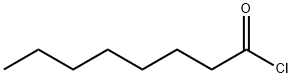
| Octanoyl chloride Basic information |
| Octanoyl chloride Chemical Properties |
| Octanoyl chloride Usage And Synthesis |
| Chemical Properties | clear liquid | | Uses | Octanoyl chloride is used to produce adhesives. It is used as an acylating agent for a variety of compounds such as sugars (e.g. Sucrose, aromatic compounds (e.g. Anisole and monoglycerides. | | Uses | Applications of octanoyl chloride include:- Synthesis of (R)-2-propyloctanoic acid, a therapeutic agent for Alzheimer′s disease.
- Synthesis of a variety of N-n-octyl-D-gluconamide based organogels.
- Building 2-heptylbenzo[d]thiazole moiety to synthesize conjugated copolymer with fluorine, as cathode interlayer in inverted polymer solar cells (PSCs).
- Octanoyl chloride is one of the essential precursors in the total synthesis of (?)-mandelalide L, a marine macrolide that display significant cytotoxicity against human cancer cell lines.
| | Preparation | Diphosgene (108.8 g) was added to a mixture of octanoic acid (144.2 g) and DMF (1.5 L) at 70 C°. The mixture was left to stand for 1 h, and then nitrogen was bubbled through it for 30 min at 100 C° to give 96.9% of octanoyl chloride (purity 99.99%). Benzoyl chloride and terephthaloyl chloride were similarly prepared. | | General Description | Clear colorless to straw-colored liquid with a pungent odor. | | Air & Water Reactions | Reacts vigorously with water to form HCl and caprylic acid. Insoluble in water. | | Reactivity Profile | Octanoyl chloride is incompatible with bases (including amines), water, alcohols, and with oxidizing agents . May react vigorously or explosively if mixed with diisopropyl ether or other ethers in the presence of trace amounts of metal salts [J. Haz. Mat., 1981, 4, 291]. | | Fire Hazard | Octanoyl chloride is combustible. |
| Octanoyl chloride Preparation Products And Raw materials |
|

 日本语
日本语 한국어
한국어 Français
 Deutsch
 España
 Türkiye