Other grades of this product :
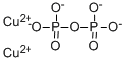
| Product Name: | Copper pyrophosphate | | Synonyms: | Cupricpyrophosphate,trihydra;pyrophosphoricacid,coppersalt;COPPER (II) PYROPHOSPHATE;COPPER(II) DIPHOSPHATE TETRAHYDRATE;COPPER PYROPHOSPHATE;Diphosphoric acid, copper salt (1:);diphosphoric acid copper salt;CUPRIC PYROPHOSPHATE | | CAS: | 10102-90-6 | | MF: | Cu2O7P2 | | MW: | 301.04 | | EINECS: | 233-279-4 | | Product Categories: | Inorganics | | Mol File: | 10102-90-6.mol |
| Copper pyrophosphate Chemical Properties |
| Copper pyrophosphate Usage And Synthesis |
| Pyrophosphate Copper Plating | Pyrophosphate copper plating is widely used copper plating process, which has been used in many electroplating plants in china. This process is characterized by its stability of plating solution, meticulous crystalline coating, a better dispersion ability and coverage ability than that of acidic copper plating and higher cathodic current efficiency than cyanide copper plating. And a thick coating can be obtained with no irritating gas escaping from the electroplating process, which can spare the ventilation equipment. Its bath solution is non-toxic, not corrosive to equipment, which makes it especially suitable for circuit printing and zinc alloy die castings. However, the preparation cost of the plating solution is high, and the long-term use (usually within a few years) will cause the accumulation of orthophosphate, so that the deposition rate will decrease significantly. In addition, direct pyrophosphate copper plating on the kinds of metal base with low electric potential such as steel, aluminum alloy and zinc alloy, will fail without preplating or pretreatment, which ensures the bonding force between the coating and the substrate.
Copper pyrophosphate, which is the main raw material for the preparation of copper plating bath, is mainly used for non-cyanide plating. It reacts in the bath with potassium pyrophosphate, the complexing agent, to form pyrophosphate copper ligand ion:
Cu2P2O7+3K4P2O7 = 2K6[Cu (P2O7) 2];
c→6K++[Cu (P2O7) 2]6-
Copper content in plating bath has a significant effect on the cathodic polarization and current density range. The copper content in plating bath is controlled at 22~27g/L in the common copper plating, and 27~35g/L for bright copper plating. Low copper content will give a low deposition rate, a narrow current density range allowed and poor brightness and smoothness; and high copper content will decrease the cathode polarization and result in a rough plating coat. In this case, to get a good coating, a corresponding increase in the content of potassium pyrophosphate is needed, but it will also increase the viscosity of the plating solution and thus reduce the conductive ability and dispersion ability of the plating bath; and the plating solution loss adhered to workpiece surface will be increased, resulting in the increase of production cost and the burden of wastewater treatment.
Because of its complexation effect on divalent bivalent copper ion and tetravalent tin ion, potassium pyrophosphate is the main complexing agent in the bath. In addition to the copper complex, there must be free to keep a certain amount of potassium pyrophosphate in the plating bath to make the complex more stable and prevent copper pyrophosphate from precipitation, therefore to improve the dispersive ability of the bath and ensure the normal dissolution of the anodes. | | Physical and Chemical Properties | Copper pyrophosphate appears as light green powder soluble in acid and not soluble in water. It can react with potassium pyrophosphate to form soluble potassium pyrophosphatecopper(Ⅱ). | | Application | Copper pyrophosphate is mainly used in non-cyanide plating, supplying copper ions in the plating bath.
Used in the copper base of decorative maskant and carburization.
Used as analytical reagent.
Used in the preparation of phosphate pigments. | | Synthesis | Double Decomposition
The copper sulfate and the anhydrous sodium pyrophosphate solution are respectively dissolved into solutions of certain concentration. After filtering and purification, the copper sulfate solution is added into the reactor, and a predetermined amount of anhydrous sodium pyrophosphate solution is added dropwise under the stirring for metathesis reaction to form copper pyrophosphate. Control pH between 5 and 5.5. And copper pyrophosphate is obtained after filtration, rinsing with water, centrifugal separation and drying. | | Chemical Properties | used in electroplating copper [HAW93] | | Flammability and Explosibility | Nonflammable |
| Copper pyrophosphate Preparation Products And Raw materials |
|


 日本语
日本语 한국어
한국어 Français
 Deutsch
 España
 Türkiye