Other grades of this product :
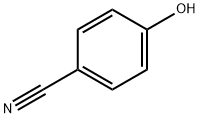
| 4-Cyanophenol Basic information |
| 4-Cyanophenol Chemical Properties |
| Melting point | 110-113 °C(lit.) | | Boiling point | 146 °C / 2mmHg | | density | 1.1871 (rough estimate) | | refractive index | 1.5800 (estimate) | | storage temp. | Inert atmosphere,Room Temperature | | solubility | methanol: 0.1 g/mL, clear | | form | Crystalline Powder | | pka | 7.97(at 25℃) | | color | Off-white to beige-gray | | Water Solubility | slightly soluble | | BRN | 386130 | | Stability: | Stable. Incompatible with strong oxidizing agents. | | CAS DataBase Reference | 767-00-0(CAS DataBase Reference) | | NIST Chemistry Reference | 4-Hydroxybenzoic acid nitrile(767-00-0) | | EPA Substance Registry System | Benzonitrile, 4-hydroxy- (767-00-0) |
| 4-Cyanophenol Usage And Synthesis |
| Chemical Properties | white crystalline powder or chips | | Uses | Intermediates of Liquid Crystals | | Uses | 4-Cyanophenol is a precursor for the synthesis of a vasodilator, Levcromakalim. Bromination of 4-cyanophenol results in bromoxynil, a commercial herbicide. It can also be used as a component of deep eutectic solvent (DES) mixture. | | Preparation | 4-Cyanophenol is produced by reaction of 4-bromophenol with copper (I) cyanide, by ammoxidation of p-cresol, by reaction of 4-chlorobenzonitrile with sodium methoxide, or by the catalyzed gas phase reaction of ethyl 4-hydroxybenzoate with ammonia. | | Synthesis Reference(s) | The Journal of Organic Chemistry, 39, p. 3343, 1974 DOI: 10.1021/jo00937a007 | | Purification Methods | Crystallise the phenol from pet ether, *benzene or water and keep it under vacuum over P2O5. [Bernasconi & Paschelis J Am Chem Soc 108 2969 1986.] [Beilstein 10 H 167, 10 IV 441.] |
| 4-Cyanophenol Preparation Products And Raw materials |
|


 日本语
日本语 한국어
한국어 Français
 Deutsch
 España
 Türkiye