Other grades of this product :
| Dichloroacetic acid Basic information |
| Dichloroacetic acid Chemical Properties |
| Melting point | 9-11 °C(lit.) | | Boiling point | 194 °C(lit.) | | density | 1.56 g/mL at 25 °C (lit.) | | vapor density | 4.5 (vs air) | | vapor pressure | 0.19 mm Hg ( 20 °C) | | refractive index | n20/D 1.466(lit.) | | Fp | >230 °F | | storage temp. | Store below +30°C. | | pka | 1.48(at 25℃) | | form | Liquid | | color | APHA: <50 | | PH | 1.2 (129g/l, H2O, 20℃) | | Water Solubility | soluble | | Sensitive | Hygroscopic | | Merck | 14,3050 | | BRN | 1098596 | | Exposure limits | ACGIH: TWA 0.5 ppm (Skin) | | Stability: | Stable. Incompatible with strong oxidizing agents, strong bases, strong reducing agents. Reacts with water. Protect from moisture. Hygroscopic. | | InChIKey | JXTHNDFMNIQAHM-UHFFFAOYSA-N | | LogP | 0.92 | | CAS DataBase Reference | 79-43-6(CAS DataBase Reference) | | NIST Chemistry Reference | Acetic acid, dichloro-(79-43-6) | | IARC | 2B (Vol. 63, 84, 106) 2014 | | EPA Substance Registry System | Dichloroacetic acid (79-43-6) |
| Dichloroacetic acid Usage And Synthesis |
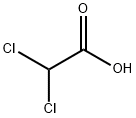
| Chemical Properties | Dichloroacetic acid, CHCI2COOH, also known as dichlorethanoic acid, is a corrosive, combustible, colorless, strong liquid acid with a pungent odor. It is soluble in water and alcohol. Dichloroacetic acid (Ka=5.14 × 10⁻²) is a stronger acid than chloroacetic acid. Most chemical reactions are similar to those of chloroacetic acid, although both chlorine atoms are susceptible to reaction. Dichloroacetic acid is much more stable to hydrolysis than chloroacetic acid. It is a reactive intermediate in organic synthesis. Dichloroacetic acid is prepared by the chlorination of acetic acid. | | Uses | Dichloroacetic acid is used as an intermediate to make other chemicals such as its salts and esters. It is involved as a test reagent for fiber analysis and a disinfectant. It is used to inhibit mitochondrial PDK (pyruvate dehydrogenase kinase) and to shift cellular metabolism from glycolysis to glucose oxidation. Further, it is used in the treatment for post-ischemic recovery. | | Preparation | Dichloroacetic acid was reported to be first synthesized in 1864 by the further chlorination of monochloroacetic acid with chlorine (Beilstein Online, 2002). The most common production method for dichloroacetic acid is the hydrolysis of dichloroacetyl chloride, which is produced by the oxidation of trichloroethylene. | | Application | Dichloroacetic acid (DCA) is a chlorinated acetic acid that has been reported to be a mouse liver carcinogen. The varying degrees of swelling of polyester in different concentrations of DCA solution has been analyzed by phase-contrast microscopy. The efficiency of titanium dioxide (TiO2) nanoparticles to catalyze the photodegradation of DCA has been investigated.Dichloroacetic acid (DCA) can be used as:A reactant in the synthesis of chloroketones by reacting with esters in the presence of LiHMDS via Claisen-type homologation reaction.A structure-directing agent, solvent, or plastdopant for the preparation of different morphologies of polyaniline (PANI). Self-assembling nanostructured PANI may be formed due to the presence of strong hydrogen bonding between DCA and aniline/polyaniline. | | Definition | ChEBI: Dichloroacetic acid is an organochlorine compound comprising acetic acid carrying two chloro substituents at the 2-position. It occurs in nature in seaweed, Asparagopsis taxiformis. It has a role as an astringent and a marine metabolite. It is a monocarboxylic acid and an organochlorine compound. It derives from an acetic acid. It is a conjugate acid of a dichloroacetate. | | General Description | Dichloroacetic acid appears as a colorless crystalline solid melting at 49°F. Corrosive to metals and tissue. | | Air & Water Reactions | Soluble in water. | | Reactivity Profile | Dichloroacetic acid is probably hygroscopic. Dichloroacetic acid reacts with water or steam. Dichloroacetic acid is incompatible with strong oxidizing agents, strong bases and strong reducing agents. | | Health Hazard | TOXIC; inhalation, ingestion or skin contact with material may cause severe injury or death. Contact with molten substance may cause severe burns to skin and eyes. Avoid any skin contact. Effects of contact or inhalation may be delayed. Fire may produce irritating, corrosive and/or toxic gases. Runoff from fire control or dilution water may be corrosive and/or toxic and cause pollution. | | Fire Hazard | Combustible material: may burn but does not ignite readily. When heated, vapors may form explosive mixtures with air: indoors, outdoors and sewers explosion hazards. Contact with metals may evolve flammable hydrogen gas. Containers may explode when heated. Runoff may pollute waterways. Substance may be transported in a molten form. | | Flammability and Explosibility | Nonflammable | | Safety Profile | Moderately toxic by
skin contact and ingestion. It is corrosive to
the skin, eyes, and mucous membranes.
Questionable carcinogen with experimental
tumorigenic data. Will react with water or
steam to produce toxic and corrosive fumes.
When heated to decomposition it emits
toxic fumes of Cl-. See also CHLORIDES. | | Potential Exposure | This haloacetic acid can be a byproduct of drinking water disinfection and may increase the risk
of cancer. This chemical is used as starting material for the
production of glyoxylic; dialkyloxy acids; and sulfonamides. It is also used as a fungicide, a medication; and
a chemical intermediate in pharmaceuticals | | Shipping | UN1764 Dichloricacetic acid, Hazard class: 8;
Labels: 8-Corrosive material. | | Purification Methods | Crystallise this strong acid from *benzene or pet ether. Dry it with MgSO4 and fractionally distil it. [Bernasconi et al. J Am Chem Soc 107 3612 1985, Beilstein 2 IV 498.] | | Incompatibilities | DCA is a medium strong acid; incompatible with nonoxidizing mineral acids; organic acids; bases,
acrylates, aldehydes, alcohols, alkylene oxides; ammonia,
aliphatic amines; alkanolamines, aromatic amines; amides,
furfuryl alcohol (explosion hazard), glycols, isocyanates,
ketones. Attacks metals generating flammable hydrogen
gas. Attacks some plastics, rubber, and coatings |
| Dichloroacetic acid Preparation Products And Raw materials |
|


 日本语
日本语 한국어
한국어 Français
 Deutsch
 España
 Türkiye