Other grades of this product :
| TC-H 106 Basic information |
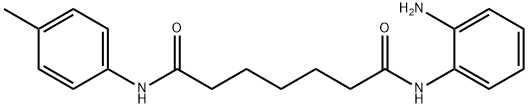
| Product Name: | TC-H 106 | | Synonyms: | TC-H 106;Pimelic Diphenylamide 106;Compound 106;Inhibitor 106;N1-(2-Aminophenyl)-N7-(4-methylphenyl)-heptanediamide;RGFA 8;N1-(2-aminophenyl)-N8-p-tolyloctanediamide;Histone Deacetylase Inhibitor VII, 106 | | CAS: | 937039-45-7 | | MF: | C20H25N3O2 | | MW: | 339.43 | | EINECS: | | Product Categories: | | Mol File: | 937039-45-7.mol |
| TC-H 106 Chemical Properties |
| storage temp. | 2-8°C | | solubility | DMSO: ≥15mg/mL | | form | Yellow solid | | color | white to beige |
| TC-H 106 Usage And Synthesis |
| Description | Pimelic diphenylamide 106 is a slow, tight-binding inhibitor of class I histone deacetylases (HDACs). Unlike the HDAC inhibitor suberoylanilide hydroamic acid, which has a fast-on/fast-off HDAC binding rate, pimelic diphenylamide 106 progressively binds HDACs and remains bound after wash-out. As a result, the IC50 of pimelic diphenylamide 106 decreases over time. With prolonged preincubation (1-3 hours), pimelic diphenylamide inhibits the class I HDACs (IC50 = 150, 760, 370, and 5,000 nM for HDAC1, 2, 3, and 8, respectively) but not the class II HDACs (IC50 > 180 μM for HDAC4, 5, and 7). Pimelic diphenylamide 106 and related benzamide HDAC inhibitors may have therapeutic value in Friedrich’s ataxia and Huntington’s disease, in part due to their low animal toxicity. | | Uses | TC-H 106 is a slow, tight-binding inhibitor of class I histone deacetylases. | | General Description | A cell-permeable p-tolylbenzamide and a Histone Deacetylase (HDAC) Inhibitor IV (Cat. No. 382170) analog that acts as a selective inhibitor against class I HDAC1,2,3 (IC50 = 0.15, 0.76, and 0.37 μM with 15, 30, and 180 min preincubation, respectively), while exhibiting much lower acitivity against class I HDAC8 (IC50 ≥ 5μM with 3 h preincubation) and no activity against class II HDAC4/5/7 even at concentrations as high as 180μM. Although the mode of inhibition is mechanistically competitive and reversible, due to the slow- and tight-binding nature, long preincubation is often required for effective in vitro enzyme inhibition, while 106-induced cellular H3 hyperacetylation is shown to persist for more than 6 hours after inhibitor removal by washing in GM15850 culture. 106 is reported to be less cytotoxic than TSA (Cat. No. 647925), MS-275, and SAHA (EC50 = 6.3, 0.328, 0.768, and 1.5 μM, respectively, in GM15850 killing). | | Biochem/physiol Actions | Pimelic diphenylamides has the ability to enhance the expression of the frataxin gene in lymphocytes from Friedreich ataxia patients. | | references | [1]. chou cj, herman d, gottesfeld jm. pimelic diphenylamide 106 is a slow, tight-binding inhibitor of class i histone deacetylases. j biol chem, 2008, 283(51): 35402-35409. [2]. xu c, soragni e, chou cj, et al. chemical probes identify a role for histone deacetylase 3 in friedreich's ataxia gene silencing. chem biol, 2009, 16(9): 980-989. [3]. rai m, soragni e, jenssen k, et al. hdac inhibitors correct frataxin deficiency in a friedreich ataxia mouse model. plos one, 2008, 3(4): e1958. |
| TC-H 106 Preparation Products And Raw materials |
|


 日本语
日本语 한국어
한국어 Français
 Deutsch
 España
 Türkiye