Other grades of this product :
| 3-HEPTANOL Basic information |
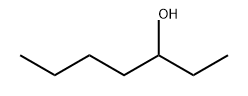
| Product Name: | 3-HEPTANOL | | Synonyms: | ALCOHOL C7;FEMA 3547;ETHYL N-BUTYLCARBINOL;DL-3-HEPTANOL;BUTYL ETHYL CARBINOL;3-Hydroxyheptane;3-HEPTYL ALCOHOL;(+/-)-3-HEPTANOL | | CAS: | 589-82-2 | | MF: | C7H16O | | MW: | 116.2 | | EINECS: | 209-661-1 | | Product Categories: | | Mol File: | 589-82-2.mol |
| 3-HEPTANOL Chemical Properties |
| Melting point | -70°C | | Boiling point | 66 °C/20 mmHg (lit.) | | density | 0.821 g/mL at 20 °C
0.818 g/mL at 25 °C (lit.) | | refractive index | n20/D 1.421(lit.) | | FEMA | 3547 | 3-HEPTANOL | | Fp | 130 °F | | storage temp. | 2-8°C | | pka | 15.31±0.20(Predicted) | | form | neat | | color | Colorless to Almost colorless | | Water Solubility | 3.984g/L(25 ºC) | | JECFA Number | 286 | | BRN | 1719067 | | CAS DataBase Reference | 589-82-2(CAS DataBase Reference) | | EPA Substance Registry System | 3-Heptanol (589-82-2) |
| Hazard Codes | Xn | | Risk Statements | 22 | | Safety Statements | 23-24/25 | | RIDADR | UN 1987 3/PG 3 | | WGK Germany | 3 | | RTECS | MJ3150000 | | HazardClass | 3 | | PackingGroup | III | | toxicity | The acute oral LD50 was reported as 4.3 g/kg and 6 g/kg in mice and as 3.25 g/kg in rats . The acute dermal LD50 in rabbits was reported as > 5 g/kg . The acute inhalation LC 50 in mice was reported as 6.6 mg/litre |
| 3-HEPTANOL Usage And Synthesis |
| Description | 3-Heptanol has a powerful, herbaceous odor and a pungent,
slightly bitter taste. May be prepared through catalytic hydrogenation
of ethyl-n-butyl ketone. | | Chemical Properties | 3-Heptanol has a powerful, herbaceous odor and a pungent, slightly bitter taste. | | Chemical Properties | Colorless, oily liquid | | Occurrence | Reported found in banana, papaya, French fried potato, peppermint oil, butter, fried or grilled beef, cognac, coffee, peated malt and rooibus tea (Aspalathius linearis) | | Uses | Flotation frother, solvent and diluent in organic
coatings, intermediates. | | Uses | 3-Heptanol can be used:- As a solvent to form microenvironments around single-walled carbon nanotubes.
- To prepare substituted pyrimidine derivatives as C1 domain-targeted isophthalate analogs to study their binding affinities towards PKCα?isoform.
- As a building block to synthesize 4-(3-adamantan-1-yl-ureido)-butyric acid and cyclohexanecarboxylic acid derivatives as sEH inhibitors.
| | Preparation | By catalytic hydrogenation of ethyl-n-butyl ketone. | | Aroma threshold values | 240 to 410 ppb. | | Synthesis Reference(s) | The Journal of Organic Chemistry, 30, p. 3760, 1965 DOI: 10.1021/jo01022a038Synthetic Communications, 26, p. 1065, 1996 DOI: 10.1080/00397919608003713 | | General Description | 3-Heptanol is the main biotransformation product of n-heptane. | | Hazard | Toxic by ingestion. Moderate fire risk. | | Biochem/physiol Actions | Odor at 1.0% | | Metabolism | In the rabbit, heptan-l-ol is metabolized partly by direct conjugation with glucuronic acid to form an ether glucuronide and mainly by oxidation to the carboxylic acid, which either undergoes further oxidation to CO2 or forms an ester glucuronide |
| 3-HEPTANOL Preparation Products And Raw materials |
|


 日本语
日本语 한국어
한국어 Français
 Deutsch
 España
 Türkiye