Other grades of this product :
| ACETYL-DL-CARNITINE HYDROCHLORIDE Basic information |
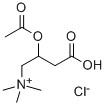
| Product Name: | ACETYL-DL-CARNITINE HYDROCHLORIDE | | Synonyms: | (+/-)-3-ACETOXY-4-(TRIMETHYLAMMONIO)BUTYRATE HYDROCHLORIDE;[+/-]-3-ACETOXY-4-(TRIMETHYLAMMONIO)BUTYRATE HYDROCHLORIDE;ACETYL-DL-CARNITINE HYDROCHLORIDE;(+/-)-ACETYLCARNITINE CHLORIDE;acetyl-dl-carnitine hcl crystalline;(±)-(2-acetoxy-3-carboxypropyl)trimethylammonium chloride;Acetyl-DL-carnitineHCl;Acetyl-DL-carnitinehydrochloridecrystalline | | CAS: | 2504-11-2 | | MF: | C9H18ClNO4 | | MW: | 239.7 | | EINECS: | 2197093 | | Product Categories: | Cholinergics;Lipid signaling | | Mol File: | 2504-11-2.mol |
| ACETYL-DL-CARNITINE HYDROCHLORIDE Chemical Properties |
| Melting point | 181 - 183°C | | storage temp. | -20°C | | solubility | DMSO (Slightly), Methanol (Slightly), Water (Slightly) | | form | Solid | | color | White to Off-White | | Stability: | Hygroscopic | | CAS DataBase Reference | 2504-11-2(CAS DataBase Reference) |
| WGK Germany | 3 | | RTECS | BP2979200 |
| ACETYL-DL-CARNITINE HYDROCHLORIDE Usage And Synthesis |
| Uses | (±)-Acetylcarnitine Chloride is a drug absorption-enhancing agent in the gastrointestinal tract. | | Biological Activity | (±)-acetylcarnitine chloride is an agonist for cholinergic.acetylcholine receptor (achr) is an integral membrane protein receptor for acetylcholine. there are two kinds of achrs: nicotinic acetylcholine receptors and muscarinic acetylcholine receptors.(±)-acetylcarnitine chloride is a cholinergic agonist and an intermediate in lipid metabolism [1]. in retinal ganglion cells, acetylcarnitine and acetylcholine inhibited gabaergic responses to exogenous gaba and gabaergic inhibitory postsynaptic currents [2].in dogs with coronary ligation, (-)-carnitine chloride (lcc) (300 mg/kg) and acetyl (-)-carnitine chloride (alcc) (300 mg/kg) inhibited the ventricular arrhythmia. also, lcc and alcc improved oxidative phosphorylation rate and the mitochondrial function [1]. in the mouse hot plate test, acetyl-l-carnitine (alcar) (100 mg/kg) exhibited analgesia. while, u-73122 and neomycin (the phospholipase c (plc) inhibitors) blocked the increase of the pain threshold induced by alcar. licl that impairing phosphatidylinositol synthesis antagonized the antinociception in a dose-dependent way. pma and pdbu (pkc activators) blocked the increase of the pain threshold in a dose-dependent way. these results suggested that alcar analgesia required the participation of the plc-ip3 pathway [3]. | | Biochem/physiol Actions | Weak cholinergic receptor agonist; intermediate in lipid metabolism. | | Purification Methods | Recrystallise the chloride from isopropanol. Dry it over P2O5 under high vacuum. The S-betaine crystallises from EtOH/Et2O with m 145o(dec) and is hygroscopic; it has [] D -19.5o (c 6, H2O). [Krimberg & Wittandt Biochem Z 251 231 1932, Strack et al. Z Physiol Chem 238 191 1936, Beilstein 4 III 1630, 1632.] |
| ACETYL-DL-CARNITINE HYDROCHLORIDE Preparation Products And Raw materials |
|


 日本语
日本语 한국어
한국어 Français
 Deutsch
 España
 Türkiye