Other grades of this product :
| 2,6-DIHYDROXY-3,9-DIMETHYLPURINE Basic information |
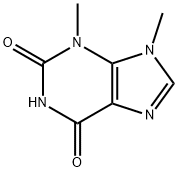
| Product Name: | 2,6-DIHYDROXY-3,9-DIMETHYLPURINE | | Synonyms: | 2,6-DIHYDROXY-3,9-DIMETHYLPURINE;3,9-dihydro-3,9-dimethyl-1H-purine-2,6-dione;9-Hydro-7-dehydro-3,9-dimethylxanthine;Einecs 239-942-4;3,9-DIMETHYLXANTHINE;1H-Purine-2,6-dione, 3,9-dihydro-3,9-dimethyl-;3,9-Dimethylxanthine >=99.0%;3,9-dimethyl-1H-purine-2,6(3H,9H)-dione | | CAS: | 15837-08-8 | | MF: | C7H8N4O2 | | MW: | 180.16 | | EINECS: | 239-942-4 | | Product Categories: | | Mol File: | 15837-08-8.mol |
| 2,6-DIHYDROXY-3,9-DIMETHYLPURINE Chemical Properties |
| Melting point | ≥300 °C | | density | 1.60±0.1 g/cm3(Predicted) | | pka | 10.48±0.20(Predicted) | | BRN | 3679243 |
| 2,6-DIHYDROXY-3,9-DIMETHYLPURINE Usage And Synthesis |
| Uses | 3,9-Dimethylxanthine has been used to study the molecular mechanism of in situ activation of ryanodine receptors (RY) in pancreatic β cells from ob/ob mice. | | General Description | 3,9-Dimethylxanthine is a xanthine derivative. It has been reported to be an activator of ryanodine receptor (RY). Mechanism of its electrochemical oxidation has been investigated in the pH range 3.0-10.8 at stationary pyrolytic graphite electrode. It has been synthesized by reacting 1-methyl-5-(methylamino)-imidazole-4-carboxamide with EtOCOCl in acetate buffer (pH5), followed by the reaction with aqueous NaOH. |
| 2,6-DIHYDROXY-3,9-DIMETHYLPURINE Preparation Products And Raw materials |
|


 日本语
日本语 한국어
한국어 Français
 Deutsch
 España
 Türkiye