Other grades of this product :
| o-Dianisidine Basic information |
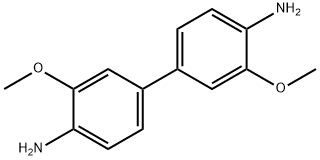
| Product Name: | o-Dianisidine | | Synonyms: | o-Dianisidine,3,3′-Dimethoxybenzidine, Fast BlueB;3.3'-Dimethoxybenzidine 1g [119-90-4];4,4'-Diamino-3,3'-dimethoxybiphenyl
3,3'-Dimethoxybenzidine
Fast Blue B;3.3'-DiMethoxy;3,3'-Dimethoxybenzidine Solution, 100ppm;[1,1'-Biphenyl]-4,4'-diamine, 3,3'-dimethoxy-;1’-biphenyl)-4,4’-diamine,3,3’-dimethoxy-(;1’-Biphenyl)-4,4’-diamine,3,3’-dimethoxy-(1 | | CAS: | 119-90-4 | | MF: | C14H16N2O2 | | MW: | 244.29 | | EINECS: | 204-355-4 | | Product Categories: | Intermediates of Dyes and Pigments;Biphenyl & Diphenyl ether | | Mol File: | 119-90-4.mol |
| o-Dianisidine Chemical Properties |
| Melting point | 137-138 °C(lit.) | | Boiling point | 387.21°C (rough estimate) | | density | 1.1079 (rough estimate) | | refractive index | 1.6000 (estimate) | | Fp | 403 °F | | storage temp. | Store at RT. | | solubility | H2O: slightly soluble | | Colour Index | 37235 | | pka | 4.71±0.10(Predicted) | | form | Crystalline Powder | | color | Pink to beige-brown | | Water Solubility | Soluble in alcohol, benzene, ether, chloroform, acetone, most organic solvents and lipids. Slightly soluble in water. | | Merck | 14,2991 | | BRN | 1879884 | | CAS DataBase Reference | 119-90-4(CAS DataBase Reference) | | NIST Chemistry Reference | Benzidine, 3,3'-dimethoxy-(119-90-4) | | IARC | 2B (Vol. 4, Sup 7) 1987 | | EPA Substance Registry System | 3,3'-Dimethoxybenzidine (119-90-4) |
| Hazard Codes | T | | Risk Statements | 45-22 | | Safety Statements | 53-45 | | RIDADR | 2811 | | WGK Germany | 3 | | RTECS | DD0875000 | | TSCA | Yes | | HazardClass | 6.1(a) | | PackingGroup | II | | HS Code | 29222990 | | Hazardous Substances Data | 119-90-4(Hazardous Substances Data) | | Toxicity | Dianisidine is a probable
carcinogen used in the manufacture of dyes. EPA has classified
as a Group 2B—probable human carcinogen. |
| o-Dianisidine Usage And Synthesis |
| Chemical Properties | o-Dianisidine, crystallizes dimorphically, rarely in needles, with mp 133°C , often in flakes with mp 137-138°C . It forms colorless crystals, but commercial products have a tinge of violet. It is sparingly soluble in water but soluble in alcohol, ether, and benzene. One gram of ethyl acetate dissolves 0.285 g of o-dianisidine at 73°C .
The pure compound is stable upon exposure to air, but commercial products turn violet. o-Dianisidine is resistant to water but sensitive to oxidizing agents.
| | Uses | o-Dianisidine is used almost exclusively as a chemical intermediate for producing dyes and pigments. In 1971, the Society of Dyers and Colourists reported its use in the production of 89 dyes (see Dyes Metabolized to o-Dianisidine, below). o-Dianisidine is also used as a chemical intermediate to produce o-dianisidine diisocyanate for use in adhesives and as a component of polyurethanes. Other uses are as a dye for paper, plastics, rubber, and textiles and as a test substance for detection of metals, thiocyanates, and nitrites (IARC 1974, HSDB 2009). | | Uses | o-Dianisidine is a starting material for the production of disazo dyes and pigments.
Like benzidine and o-tolidine, o-dianisidine forms colors with numerous oxidizing agents, e.g., copper, cobalt, and gold ions. o-Dianisidine is quantitatively determined by titration with nitrite using potassium iodide and starch paper as the indicator. o-Dianisidine can be detected in the urine using potassium 1,2-naphthoquinone4-sulfonate after extraction. A rapid and easy method is based on the color formed with cyanogen bromide. Its detection limit is 0.05 mg/kg.
The free o-dianisidine base and the dihydrochloride are marketed in moist forms with a 10-30% water content.
| | Uses | o-Dianisidine is used as a redox indicator. It is used as an intermediate for the preparation of azo dyes, pigments and o-dianisidine diisocyanate, which finds application in adhesives, polyurethane elastomers and resins. It is also used in various industries like leather, paper, plastics, rubber, and textiles. It acts as a reagent to detect metals, thiocyanates, and nitrites. | | Preparation | 2-Nitroanisole is reduced (H2-catalyst or iron-formic acid) to o-anisidine or (benzidine-type reaction) to o-dianisidine [119-90-4], both of which are important as dye intermediates. | | Synthesis Reference(s) | Journal of the American Chemical Society, 106, p. 7077, 1984 DOI: 10.1021/ja00335a035 | | General Description | Colorless crystals or a light brown powder. Turns violet on standing. Carcinogen. | | Air & Water Reactions | Finely powdered material is a significant dust explosion hazard. Insoluble in water. | | Reactivity Profile | o-Dianisidine is a weak base. Reacts exothermically with acids. Sensitive to heat, air and prolonged exposure to light. | | Fire Hazard | o-Dianisidine is combustible. | | Safety Profile | Confirmed carcinogen
with experimental tumorigenic data.
Moderately toxic by ingestion. Mutation data
reported. Combustible when exposed to
heat or flame. When heated to
decomposition it emits toxic fumes of NOx. | | Carcinogenicity | o-Dianisidine is reasonably anticipated to be a human carcinogen based on sufficient evidence of carcinogenicity from studies in experimental animals. | | Properties and Applications | red light navy blue light to dark. And C.I.Azoic Diazo Component 48 the same chemical structure.
|
Standard(Polyamide)
|
Ironing Fastness
|
Light Fastness
|
Persperation Fastness
|
Washing Fastness
|
|
Fading
|
Stain
|
Fading
|
Stain
|
Fading
|
Stain
|
|
AATCC
|
2
|
5
|
5
|
5
|
5
|
|
| o-Dianisidine Preparation Products And Raw materials |
| Raw materials | 2-Nitroanisole-->o-Dianisidine | | Preparation Products | 3,3'-Dihydroxybenzidine-->Direct Blue 151-->disodium 3-[[4'-[[6-amino-1-hydroxy-3-sulphonato-2-naphthyl]azo]-3,3'-dimethoxy[1,1'-biphenyl]-4-yl]azo]-4-hydroxynaphthalene-1-sulphonate-->CHICAGO SKY BLUE 6B-->3,3'-dihydroxy-[1,1'-biphenyl]-4,4'-dicarboxylic acid-->BENZOAZURINE-->1-Naphthalenesulfonic acid, 4-amino-5-hydroxy-6-[[4'-[(4-hydroxyphenyl)azo]-3,3'-dimethoxy[1,1'-biphenyl]-4-yl]azo]-, monosodium salt-->1,6-Naphthalenedisulfonic acid, 7-[[4'-[(6-amino-1-hydroxy-3-sulfo-2-naphthalenyl)azo]-3,3'-dimethoxy[1,1'-biphenyl]-4-yl]azo]-8-hydroxy-, trisodium salt-->tetrasodium [mu-[[3,3'-[(3,3'-dihydroxy[1,1'-biphenyl]-4,4'-diyl)bis(azo)]bis[4,5-dihydroxynaphthalene-2,7-disulphonato]](8-)]]dicuprate(4-)-->C.I. Direct Black 87-->CHICAGO SKY BLUE 6B-->DIRECTVIOLET32-->2,7-Naphthalenedisulfonic acid, 3,3'-[(3,3'-dimethoxy[1,1'-biphenyl]-4,4'-diyl)bis(azo)]bis[5-chloro-4-hydroxy-, tetrasodium salt-->1-Naphthalenesulfonic acid, 3-[[4'-[(2,4-diamino-5-methylphenyl)azo]-3,3'-dimethoxy[1,1'-biphenyl]-4-yl]azo]-4,6-dihydroxy-, monosodium salt-->2-Naphthalenesulfonic acid, 6-amino-3-[[4'-[(4-amino-6-sulfo-1-naphthalenyl)azo]-3,3'-dimethoxy[1,1'-biphenyl]-4-yl]azo]-4-hydroxy-, disodium salt-->DIRECT BLACK 91-->Direct Blue 151-->DIRECT BLUE 98-->Direct blue 215 (C.I. 24415)-->DIRECT BLUE 80 |
|


 日本语
日本语 한국어
한국어 Français
 Deutsch
 España
 Türkiye