Other grades of this product :
| NAPTALAM Basic information |
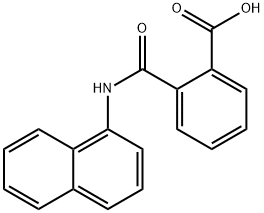
| Product Name: | NAPTALAM | | Synonyms: | 2-((1-naphthalenylamino)carbonyl)-benzoicaci;2-((1-naphthalenylamino)carbonyl)benzoicacid;6q8;acp322;1-N-NAPHTHYLPHTHALAMIC ACID (NPA);peachthin322;solo;NPA | | CAS: | 132-66-1 | | MF: | C18H13NO3 | | MW: | 291.3 | | EINECS: | | Product Categories: | | Mol File: | 132-66-1.mol |
| NAPTALAM Chemical Properties |
| Melting point | 185-190 °C | | Boiling point | 433.31°C (rough estimate) | | density | d420 1.40 | | refractive index | 1.4800 (estimate) | | storage temp. | Sealed in dry,Room Temperature | | form | neat | | pka | 3.45±0.36(Predicted) | | color | White to Gray to Dark blue | | Water Solubility | 0.2g/L(room temperature) | | Merck | 14,6418 | | BRN | 2814102 | | Stability: | Stable. Incompatible with strong oxidizing agents. | | CAS DataBase Reference | 132-66-1(CAS DataBase Reference) | | EPA Substance Registry System | Naptalam (132-66-1) |
| Risk Statements | 36/37/38 | | Safety Statements | 26-36/37/39 | | RIDADR | UN3077 (solid); UN3082
(liquid) | | WGK Germany | 2 | | RTECS | TH7350000 | | HS Code | 29242990 | | Hazardous Substances Data | 132-66-1(Hazardous Substances Data) | | Toxicity | LC50 (96-hour) for bluegill sunfish 354 mg/L and rainbow trout 76 mg/L (Hartley
and Kidd, 1987); acute oral LD50 of the free acid and sodium salt for rats >8,200 and
1,800 mg/kg, respectively (Ashton and Monaco, 1991). |
| NAPTALAM Usage And Synthesis |
| Chemical Properties | solid with an unpleasant odour | | Uses | Selective preemergence herbicide used to control some grasses and many broadleaved
weeds in soybeans, cucurbits, asparagus, groundnuts, potatoes and established
woody ornamentals. | | Uses | N-(1-Naphthyl)phthalamic Acid is an auxin-transport inhibitor in plants resulting in the attenuation of root growth through decreasing the cell production rate. | | Definition | ChEBI: A dicarboxylic acid monoamide which results from addition of one equivalent of 1-naphthylamine to phthalic anhydride. | | General Description | Naptalam is a purple crystalline solid, which can be used as an anti-geotropic agent and as an auxin (IAA) antagonist in plants. | | Agricultural Uses | Herbicide: Used as a selective pre-emergence herbicide to control
broadleaf weeds and grasses in soybeans, cucumbers,
melons, peanuts and woody ornamentals. Not currently
registered for use in the U.S. or EU countries. There are
25 global suppliers. | | Trade name | N-1-naphthyl-
Trade Names: ALANAP®[C]; ALANAPE®;
ANCRACK®; DYANAP®; GRELUTIN®; MORCRAN
®; NAPTRO®; NIP-A-THIN®; PEACH-THIN®;
RESCUE®[C]; 6Q8®; SOLO® | | Environmental Fate | Soil/Plant. Degrades in soils and plants forming 1-naphthylamine and phthalic acid
(Hartley and Kidd, 1987; Humburg et al., 1989). Residual activity in soil is limited to
approximately 3 to 4 months (Hartley and Kidd, 1987).Chemical/Physical. Forms N-(1-naphthyl)phthalimide at elevated temperatures (Worthing
and Hance, 1991). Naptalam will precipitate as the free acid in very acidic waters
or in extremely hard waters (Humburg et al., 1989). | | Purification Methods | Crystallise the herbicide from EtOH (m 183-185o). The Na salt has m 185o. [Beilstein 12 H 1236, 12 I 525, 12 III 2876.] |
| NAPTALAM Preparation Products And Raw materials |
|


 日本语
日本语 한국어
한국어 Français
 Deutsch
 España
 Türkiye