Other grades of this product :
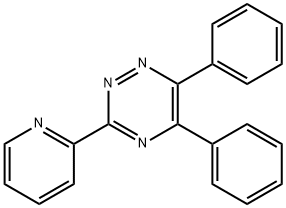
| 3-(2-PYRIDYL)-5,6-DIPHENYL-1,2,4-TRIAZINE Basic information |
| Product Name: | 3-(2-PYRIDYL)-5,6-DIPHENYL-1,2,4-TRIAZINE | | Synonyms: | TIMTEC-BB SBB008869;PDT;3-(2-PYRIDYL)-5,6-DIPHENYL-1,2,4-TRIAZINE;5,6-DIPHENYL-3-(2-PYRIDYL)-1,2,4-TRIAZINE;5,6-Diphenyl-3-(2-pyridyl)-1,2,4-triazine~PDT;3-(2-PYRIDYL)-5,6-DIPHENYL-1,2,4-TRIAZIN E, 99+%;3-(2-PYRIDYL)-5,6-DIPHENYL-1,2,4-TRIAZINE (PDT);3-(2-PYRIDYL)-5,6-DIPHENYLTRIAZINE | | CAS: | 1046-56-6 | | MF: | C20H14N4 | | MW: | 310.35 | | EINECS: | 213-878-7 | | Product Categories: | Heterocyclic Compounds;Analytical Chemistry;Bipyridyls, etc. (Chelating Reagents);Chelating Reagents | | Mol File: | 1046-56-6.mol |
| 3-(2-PYRIDYL)-5,6-DIPHENYL-1,2,4-TRIAZINE Chemical Properties |
| Melting point | 191-193 °C (lit.) | | Boiling point | 440.52°C (rough estimate) | | density | 1.2028 (rough estimate) | | refractive index | 1.6400 (estimate) | | storage temp. | Inert atmosphere,Room Temperature | | form | powder to crystal | | pka | -0.06±0.63(Predicted) | | color | Light yellow to Yellow to Orange | | Water Solubility | Soluble in water. | | BRN | 542151 | | Stability: | Stable. Incompatible with strong acids, strong oxidizing agents. | | CAS DataBase Reference | 1046-56-6(CAS DataBase Reference) | | EPA Substance Registry System | 1,2,4-Triazine, 5,6-diphenyl-3-(2-pyridinyl)- (1046-56-6) |
| Hazard Codes | Xi | | Risk Statements | 36/37/38 | | Safety Statements | 26-36 | | WGK Germany | 3 | | RTECS | XY8598150 | | TSCA | Yes | | HS Code | 29336990 |
| 3-(2-PYRIDYL)-5,6-DIPHENYL-1,2,4-TRIAZINE Usage And Synthesis |
| Chemical Properties | yellow powder | | Uses | 3-(2-Pyridyl)-5,6-diphenyl-1,2,4-triazine was employed as chromogenic-extraction reagent during spectrophotometric determination of iron in acids and acidic solutions. It was also employed as precolumn derivatizing reagent in the HPLC method with UV absorbance detection for the Fe(II) determination. | | Indications | PDT with 20% ALA may be used for the treatment of actinic keratoses. The product is marketed as Levulan Kerastick (DUSA Pharmaceuticals, Valhalla, New York). The ALA is applied diffusely over the field with an applicator; the patient returns 1 to 3 hours later and is exposed to an activating light source. Once exposed to the light, ALA produces singlet oxygen, which damages the cell membrane. Sixty-six percent of patients had total clearing of lesions at 8 weeks using blue light exposure for 15 minutes. Patients experience a burning pain but heal with an excellent cosmetic result. Photosensitivity lasts for 24 hours. An optional regimen is to apply ALA only to visible actinic keratoses; however, this method will not treat subclinical lesions. A variety of lasers and light sources can be used to activate the ALA, including blue light, yellow light, and broadband light; however, many details remain to be worked out, such as the optimal incubation times for the ALA when using each of the various light sources. | | General Description | 3-(2-Pyridyl)-5,6-diphenyl-1,2,4-triazine (PDT) reacts with Cu(II) perchlorate in ethanol to yield [Cu(PDT)2(ClO4)2]. | | Purification Methods | Purify it by repeated recrystallisation from EtOH/dimethylformamide. It is a reagent for estimating Fe(II) and Ru(II). [Chriswell & Schilt Anal Chem 46 992 1974, Kamra & Ayers Anal Chem 78 423 1975.] |
| 3-(2-PYRIDYL)-5,6-DIPHENYL-1,2,4-TRIAZINE Preparation Products And Raw materials |
|


 日本语
日本语 한국어
한국어 Français
 Deutsch
 España
 Türkiye