Other grades of this product :
| 2-(DIBUTYLAMINO)ETHANOL Basic information |
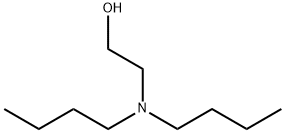
| Product Name: | 2-(DIBUTYLAMINO)ETHANOL | | Synonyms: | 2-(dibutylamino)-ethano;2-Ethamolamine, N,N-dibutyl-;2-N-Dibutylaminoethanol;beta-N-Dibutylaminoethyl alcohol;beta-n-dibutylaminoethylalcohol;Bu2ae;Di(n-butyl)ethanolamine;N,N-Dibutyl-2-hydroxyethylamine | | CAS: | 102-81-8 | | MF: | C10H23NO | | MW: | 173.3 | | EINECS: | 203-057-1 | | Product Categories: | alcohols | | Mol File: | 102-81-8.mol |
| 2-(DIBUTYLAMINO)ETHANOL Chemical Properties |
| Melting point | -70°C(lit.) | | Boiling point | 229-230 °C(lit.) | | density | 0.86 g/mL at 25 °C(lit.) | | vapor density | 6 (vs air) | | vapor pressure | 5Pa at 20℃ | | refractive index | n20/D 1.444(lit.) | | Fp | 197 °F | | solubility | Practically insoluble in water | | pka | 14.77±0.10(Predicted) | | form | Colorless liquid | | color | Colorless to Light orange to Yellow | | Water Solubility | 4g/L at 20℃ | | BRN | 1738441 | | Stability: | Stable. Combustible. Incompatible with strong oxidizing agents. | | InChIKey | IWSZDQRGNFLMJS-UHFFFAOYSA-N | | LogP | 1.86 at 20℃ | | CAS DataBase Reference | 102-81-8(CAS DataBase Reference) | | EPA Substance Registry System | 2-(Dibutylamino)ethanol (102-81-8) |
| Hazard Codes | C | | Risk Statements | 21/22-34 | | Safety Statements | 26-36/37/39-45 | | RIDADR | UN 2873 6.1/PG 3 | | WGK Germany | 1 | | RTECS | KK3850000 | | HazardClass | 6.1(b) | | PackingGroup | III |
| 2-(DIBUTYLAMINO)ETHANOL Usage And Synthesis |
| Chemical Properties | colourless liquid | | Chemical Properties | 2-Di-n-butylaminoethanol is a colorless to
yellowish liquid. Faint amine-like odor. | | Uses | Dibutylaminoethanol
has found use as a conditioning agent for cellulose
acetate filaments to facilitate textile manufacture, a catalyst
in polyurethane foam manufacture, and an anticorrosion
additive for lubricants and hydraulic fluids, in the manufacture
of emulsifying and dispersing agents, and in the curing of
silicone resins. | | Uses | Organic syntheses | | Uses | 2-(Dibutylamino)ethanol (DBAE) may be used as a coreactant to enhance the electrochemiluminescence (ECL) of tris(2,2′-bipyridyl)ruthenium(II) [Ru(bpy)32+], employed in the ECL immunoassays and DNA probe assays. DBAE may also be used as a catalyst during the synthesis of protected D-erythro-(2S,3R)-sphingosine. | | General Description | 2-(DIBUTYLAMINO)ETHANOL is a colorless liquid with a mild fishlike odor. Flash point 200°F. Toxic by ingestion and skin absorption. Used to make other chemicals. | | Air & Water Reactions | Insoluble in water. | | Reactivity Profile | 2-(DIBUTYLAMINO)ETHANOL is an aminoalcohol. Amines are chemical bases. They neutralize acids to form salts plus water. These acid-base reactions are exothermic. The amount of heat that is evolved per mole of amine in a neutralization is largely independent of the strength of the amine as a base. Amines may be incompatible with isocyanates, halogenated organics, peroxides, phenols (acidic), epoxides, anhydrides, and acid halides. Flammable gaseous hydrogen is generated by amines in combination with strong reducing agents, such as hydrides. | | Health Hazard | TOXIC; inhalation, ingestion or skin contact with material may cause severe injury or death. Contact with molten substance may cause severe burns to skin and eyes. Avoid any skin contact. Effects of contact or inhalation may be delayed. Fire may produce irritating, corrosive and/or toxic gases. Runoff from fire control or dilution water may be corrosive and/or toxic and cause pollution. | | Fire Hazard | Combustible material: may burn but does not ignite readily. When heated, vapors may form explosive mixtures with air: indoors, outdoors and sewers explosion hazards. Contact with metals may evolve flammable hydrogen gas. Containers may explode when heated. Runoff may pollute waterways. Substance may be transported in a molten form. | | Flammability and Explosibility | Nonflammable | | Safety Profile | Poison by
intraperitoneal route. Moderately toxic by
ingestion and skin contact. A severe eye and
skin irritant. Combustible; can react with
oxidizing materials. To fight fire, use CO2,
dry chemical. When heated to
decomposition it emits toxic fumes of NOx.
See also AMINES and ALCOHOLS | | Potential Exposure | This material is used in organic
synthesis. | | Shipping | UN2735 Amines, liquid, corrosive, n.o.s, or
Polyamines, liquid, corrosive, n.o.s., Hazard class: 8;
Labels: 8-Corrosive material, Technical Name Required. | | Incompatibilities | Incompatible with oxidizers (chlorates,
nitrates, peroxides, permanganates, perchlorates, chlorine,
bromine, fluorine, etc.); contact may cause fires or explo-
sions. Keep away from alkaline materials, strong bases,
strong acids, oxoacids, and epoxides. |
| 2-(DIBUTYLAMINO)ETHANOL Preparation Products And Raw materials |
|


 日本语
日本语 한국어
한국어 Français
 Deutsch
 España
 Türkiye