Other grades of this product :
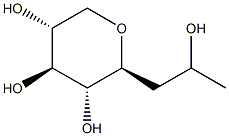
| Product Name: | Pro-xylane | | Synonyms: | (2S,3R,4S,5R)-2-(2-hydroxypropyl)oxane-3,4,5-triol;Nano liposomal hydroxypripyl tetrahydropyrantriol;Retinol Pro+Pro-xylane;Pro-Xylane,Puri-Xylane;HYDROXYPROPYL TETRAHYDROPYRANTRIOL;Puri-Xylane;Nano Liposomal HYDROXYPROPYL TETRAHYDROPYRANTRIOL;Tetrahydropyrantriol | | CAS: | 439685-79-7 | | MF: | C8H16O5 | | MW: | 192.21 | | EINECS: | 456-880-5 | | Product Categories: | API;439685-79-7 | | Mol File: | 439685-79-7.mol |
| Pro-xylane Chemical Properties |
| Boiling point | 376.0±42.0 °C(Predicted) | | density | 1.368±0.06 g/cm3(Predicted) | | vapor pressure | 0Pa at 25℃ | | pka | 13.55±0.70(Predicted) | | LogP | -2.07 |
| Pro-xylane Usage And Synthesis |
| cosmetic ingredient | Pro-Xylane is a cosmetic ingredient used mainly as an anti-ageing agent in skin creams. Produced by Chimex, its chemical structure is derived from the xylose, a natural component of glycosaminoglycans and of hemicellulose. Pro-Xylane is produced in a two-steps process: 1) The reaction of xylose and acetylacetone in water, then 2) the hydrogenation of the intermediate. | | Physical Form | Powder | | Cosmetics Application | Pro-Xylane is a biochemical which induces neo-synthesis of matrix proteins. It is a biologically active C-glycoside in aqueous media, acts as an activator of glycosaminoglycans (GAGs) biosynthesis. Pro-xylane is the first example of 'Green' chemical used in cosmetic.
Pro-Xylane is an ingredient originally developed by Lancome in 2006. According to research, it is a sugar-protein hybrid made from xylose, a sugar found abundantly in beech trees and known to stimulate the production of glycoaminoglycans (GAGs), molecules responsible for defending the skin against water loss. | | function | Pro-Xylane is a sugar-molecule derived from the beech wood tree utilizing green chemistry. It functions, in vitro, by stimulating the production of proteoglycans, a water-absorbing molecule in human reconstructed skin. | | Uses | Pro-Xylane is a sugar-molecule derived from the beech wood tree utilizing green chemistry. It functions, in vitro, by stimulating the production of proteoglycans, a water-absorbing molecule in human reconstructed skin. Higher levels of proteoglycans within the reconstructed skin’s extracellular matrix correlate to increase skin-elasticity and firmness. In cosmetics, pro-xylane products are frequently incorporated into anti-aging lotions and creams to counterbalance signs of aging (i.e., fine lines and wrinkles). |
| Pro-xylane Preparation Products And Raw materials |
|


 日本语
日本语 한국어
한국어 Français
 Deutsch
 España
 Türkiye