Other grades of this product :
| 2-Methylcyclohexanol Basic information |
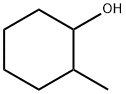
| Product Name: | 2-Methylcyclohexanol | | Synonyms: | 2-HYDROXY-1-METHYLCYCLOHEXANE;2-methylcyclohexylalcohol;2-metilcicloesanone;Cyclohexanol, o-methyl-;o-methyl-cyclohexano;2-METHYLHEXALIN;2-METHYLCYCLOHEXANOL;2-METHYLCYCLOHEXAN-1-OL | | CAS: | 583-59-5 | | MF: | C7H14O | | MW: | 114.19 | | EINECS: | 209-512-0 | | Product Categories: | Industrial/Fine Chemicals | | Mol File: | 583-59-5.mol |
| 2-Methylcyclohexanol Chemical Properties |
| Melting point | -38 °C | | Boiling point | 171-173 °C(lit.) | | density | 0.93 g/mL at 25 °C(lit.) | | refractive index | n20/D 1.463 | | Fp | 138 °F | | form | Liquid | | pka | 15.33±0.40(Predicted) | | Specific Gravity | 0.930 (20/4℃) | | color | Clear colorless | | Water Solubility | slightly soluble | | BRN | 1847535 | | Stability: | Stable. Combustible. Incompatible with strong oxidizing agents. | | CAS DataBase Reference | 583-59-5(CAS DataBase Reference) | | NIST Chemistry Reference | Cyclohexanol, 2-methyl-(583-59-5) | | EPA Substance Registry System | Cyclohexanol, 2-methyl- (583-59-5) |
| Hazard Codes | Xn | | Risk Statements | 20-36-20/22 | | Safety Statements | 24/25 | | RIDADR | UN 2617 3/PG 3 | | WGK Germany | 1 | | RTECS | GW0220000 | | TSCA | Yes | | HazardClass | 3 | | PackingGroup | III | | HS Code | 29061200 |
| 2-Methylcyclohexanol Usage And Synthesis |
| Chemical Properties | colourless viscous liquid with an aromatic odour. Less dense than water and insoluble in water. Hence floats on water. | | Uses | 2-Methylcyclohexanol is used in the preparation of acetic acid-(2-methyl-cyclohexyl ester) by reaction with acetic anhydride. Further, it is used to study the effect of organic solvents on epoxide hydrolase. | | Reactions | 2-methylcyclohexanol undergoes a dehydration reaction when reacted with conc. Sulfuric acid to form a mixture of 1-metyl and 3-methylcyclohexene. | | Reactivity Profile | 2-METHYLCYCLOHEXANOL is an alcohol. Flammable and/or toxic gases are generated by the combination of these materials with alkali metals, nitrides, and strong reducing agents. Contact with strong oxidizers may cause fires and explosions. They react with oxoacids and carboxylic acids to form esters plus water. Oxidizing agents convert them to aldehydes or ketones. They exhibit both weak acid and weak base behavior. They may initiate the polymerization of isocyanates and epoxides. Special Hazards of Combustion Products: Irritating vapors and toxic gases, such as carbon monoxide, may be formed when involved in fire (USCG, 1999). | | Purification Methods | Dry 2-methylcyclohexanol with Na2SO4 and fractionate it under vacuum. Note: The cis-isomer has b 165o/760mm, and the trans-isomer has b 166.5o/760mm. [Eliel & Haber J Org Chem 23 2041 1958, Beilstein 6 III 61, 6 IV 100.] |
| 2-Methylcyclohexanol Preparation Products And Raw materials |
|


 日本语
日本语 한국어
한국어 Français
 Deutsch
 España
 Türkiye